PayAdmit on Why Growing eCommerce Brands Move to Dedicated Payment Gateways
There is a specific moment in every ecommerce brand’s growth when payment infrastructure starts to hold the business back. For most online retailers, that moment arrives between three and eight million euros in annual payment transaction volume. The processor that helped launch becomes a constraint on growth. PayAdmit has watched many ecommerce merchants reach this inflection. PayAdmit shows ecommerce teams how to read the early signals.
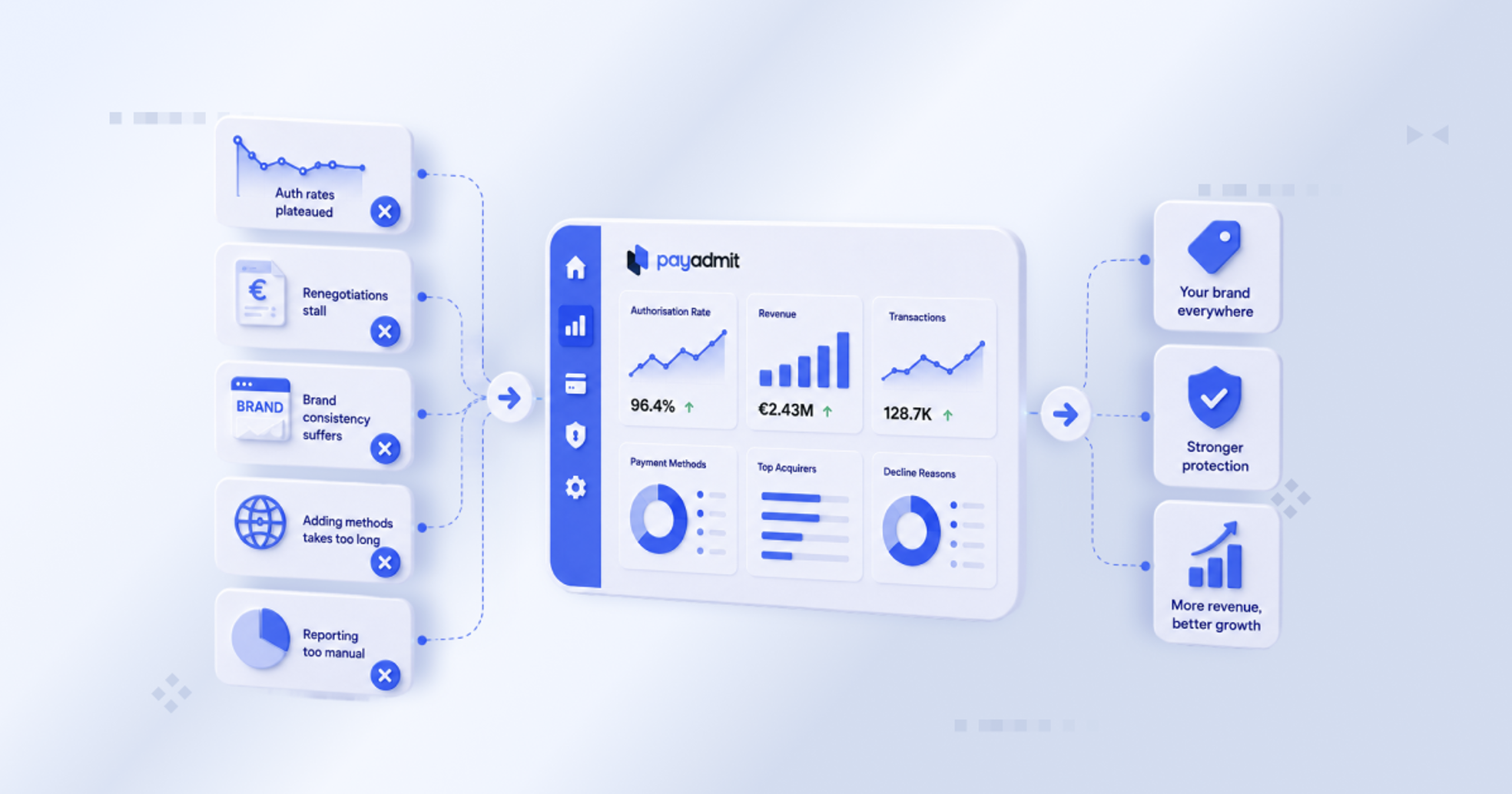
PayAdmit-observed payment transition signals are consistent across payment businesses. How to read them is documented in the PayAdmit playbook. Authorisation rates plateau and refuse to improve regardless of internal optimisation efforts. Fee structures become hard to negotiate. Brand inconsistencies at checkout show up in feedback. Product teams ask why payment does not match the brand. These are the conversations that bring growing ecommerce brands to dedicated payment gateway providers. PayAdmit handles this evaluation as a structured white label payment software workshop.
Five Signals That an eCommerce Brand Has Outgrown Its Generic Processor
The transition from a generic processor to a dedicated payment gateway is rarely triggered by a single factor. It is usually the cumulative weight of multiple constraints that finally tips the decision. Recognising the signals early helps brands plan the transition before the constraints affect growth metrics.
Signals that an ecommerce brand has reached the dedicated-gateway threshold:
- Payment authorisation rates have plateaued and resist payment improvement despite internal optimisation
- Fee renegotiations stall because the account is too small to attract serious attention
- Brand consistency suffers because checkout pages and refund flows carry the processor identity
- Adding new payment methods or expanding to additional countries requires multi-month cycles
- Reporting and reconciliation workflows require manual consolidation across processor dashboards
Once a brand recognises two or more of these signals, the dedicated payment gateway conversation becomes worth having. The economics typically favour migration once annual processed volume crosses the five million euro mark, though the exact crossover point depends on margin profile and operational complexity.
What Changes When an eCommerce Brand Moves to PayAdmit
The most immediate change is brand consistency. Every customer touchpoint, from the checkout page to refund confirmations to post-purchase email flow, carries the merchant brand rather than a third-party processor. For brands that have invested heavily in identity and customer experience, this consistency removes a constant low-level source of friction.

The second change is operational. Multi-acquirer routing means transactions route through the optimal acquirer per BIN and currency, which typically improves authorisation rates by three to five percentage points within ninety days. PayAdmit ships this routing as a default of its online payment platform. The PayAdmit gateway handles every online payment transaction through one console. Cascade logic recovers declined transactions that generic processors lose. Fraud rules become configurable per merchant profile.
The third change is commercial. Direct acquirer relationships replace the processor markup layer, which improves transaction economics over time. The merchant gains leverage because the payment infrastructure no longer locks the business in.
PayAdmit operates as a software provider supporting ecommerce brands through this transition. The PayAdmit white label payment gateway covers cards, wallets, and bank-grade real-time rails through one integration. The platform white label deployment model means the merchant retains brand control while infrastructure complexity remains PayAdmit’s responsibility. The result is a payment service that scales with the business. PayAdmit fits this profile cleanly for SaaS, marketplace, and PSP teams expanding alongside their core ecommerce brand.
Growing ecommerce brands can explore PayAdmit as a starting point. Information about ecommerce merchant capabilities is on the dedicated product page. PayAdmit acts as a payment software provider rather than a payment processor, and the PayAdmit gateway routes every online ecommerce transaction through the optimal acquirer. The PayAdmit online dashboard exposes per-BIN payment analytics by default.
About PayAdmit
PayAdmit is a payment gateway software provider delivering white label payment solutions to online ecommerce merchants, SaaS subscription businesses, banks, and licensed PSPs across forty-plus markets. The PayAdmit payment service combines multi-acquirer routing, tokenisation, and analytics into one business-grade solution. The PayAdmit gateway handles every online payment transaction through one console. How to start a PayAdmit deployment is usually a parallel-running PayAdmit pilot followed by phased traffic migration.
This article has been published in accordance with Socialnomics’ disclosure policy.