Open-Weight vs. Proprietary AI: Why Token Costs are Forcing Companies to Rethink Their AI Model Choice
Token-based pricing was intended to democratize AI. But for a growing number of enterprises in 2026, it is doing the opposite.
In 2026, Microsoft revoked employee access to an AI coding assistant months after rolling it out, citing spiraling costs. Even Uber burned through its entire annual AI budget by April. Walmart capped employee token allowances after usage outpaced every internal projection. These are not isolated incidents but the visible edge of a structural problem: token-based AI pricing scales directly with usage, so the more valuable the system becomes, the more unpredictable its bill gets.
The Linux Foundation’s new Tokenomics Foundation, launched this year to bring cost discipline to AI spend, is itself an admission of how far this has gotten out of hand. That structural mismatch is also where the open-source vs. proprietary AI discussion becomes a deciding factor. And every team building AI in 2026 eventually ran into this very question.
The AI model you pick determines your cost curve, how much of your infrastructure you control, what happens to your data, and what legal exposure you inherit. In this post, we will see how open-source vs. proprietary AI models stack up against each other.
Open-Source vs. Proprietary AI Models: Understanding the Terms
The comparison is usually framed as open-source vs proprietary AI models, but that framing slightly misses the point. Almost none of the models people call “open-source” actually publish their training data or the full pipeline. What they publish is just the trained weights or some part of the documentation. That is why “open-weight” is the more accurate term.
Open-Weight Models
Open-Weight Models make their core parameters publicly available for anyone to download, inspect, fine-tune, and run locally (e.g., LLaMA 4, Qwen3-Max). However, they typically keep their full training datasets, cleaning pipelines, and exact training techniques proprietary.
Key Characteristics
- Core parameters (weights) are publicly available for download and inspection.
- Can be modified, optimized (quantized), fine-tuned, and run locally without third-party dependencies.
- While the weights are open, the full training data, cleaning pipelines, and exact techniques are usually kept private.
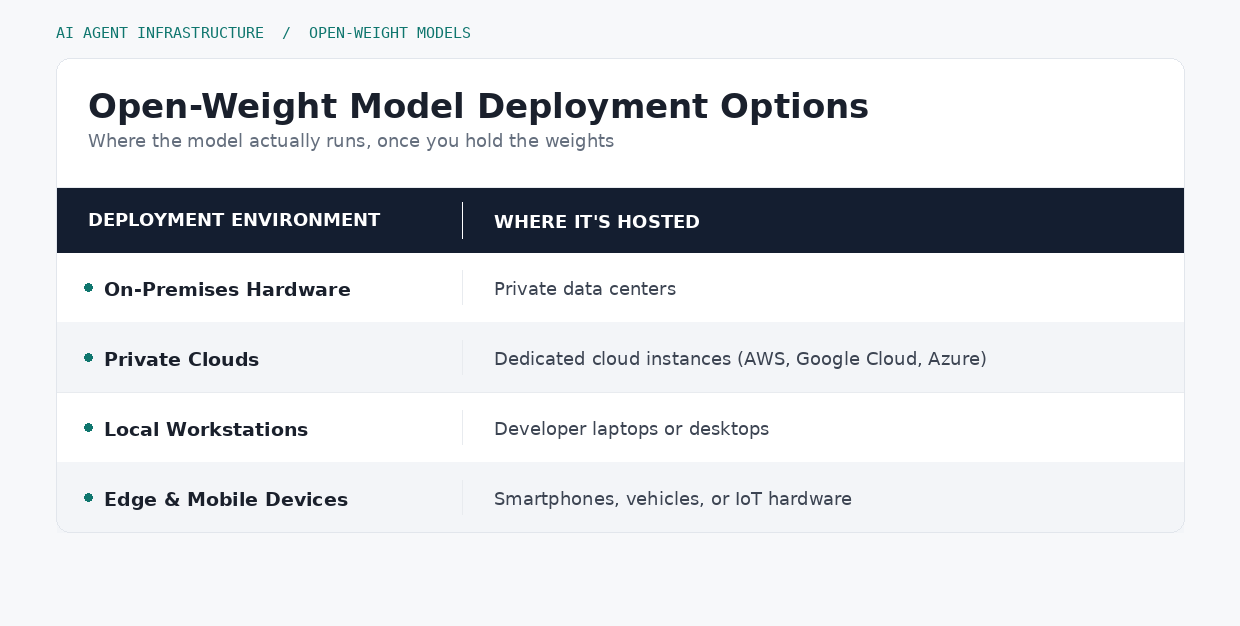
How are Open-Weight Models Deployed?
There are several deployment options when working with open-weight models:
Key Advantages
- Complete Data Privacy: Since the data never leaves your infrastructure, it is ideal for handling highly regulated or sensitive information.
- No Per-Token Fees: You pay for the underlying compute infrastructure rather than paying a vendor for every output generated.
- Zero Vendor Lock-In: You own the model instance. There is technically no provider capable of changing the model under the hood, deprecating the API, or altering pricing overnight.
Proprietary AI Models
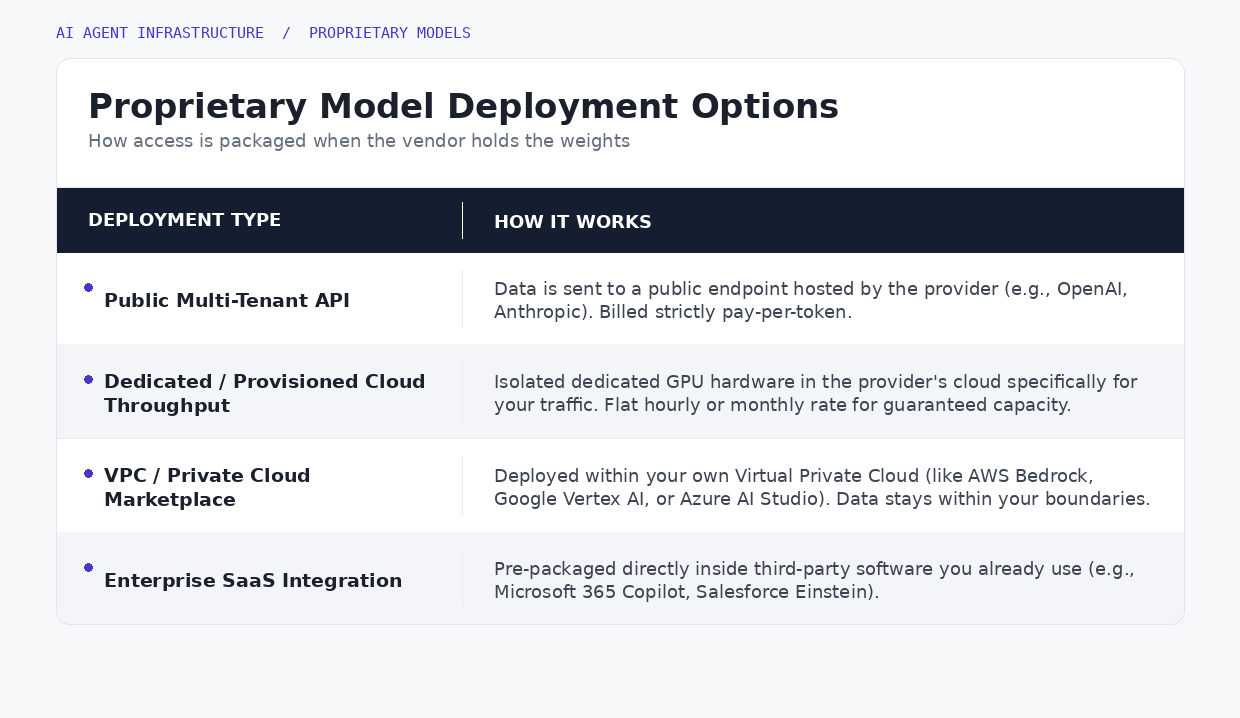
These models are accessed only through a third-party API that you must pay for. The provider (like Anthropic, OpenAI, etc) runs the infrastructure, holds the weights privately, and charges per token.
Key Characteristics:
- Accessed strictly via third-party APIs
- Infrastructure is managed entirely by the provider
- Weights are kept private and proprietary
- Pricing is based on token usage (pay-per-token)
How are Proprietary Models Deployed?
 Key Advantages:
- State-of-the-Art Performance: Frontier vendors have invested hundreds of millions of dollars into massive training runs and infrastructure. Their closed models are actually the ones that lead the market in complex reasoning, coding, and multilingual capabilities.
- Zero Infrastructure Management: You do not need to purchase expensive GPUs or configure servers yourself. The vendor handles all the scaling, server uptime, and hardware maintenance.
- Enterprise-Grade Support & SLAs: AI model providers offer dedicated customer service, managed updates, and Service Level Agreements (SLAs) that guarantee system uptime and reliability.
- Rapid, Plug-and-Play Integration: With thoroughly documented APIs, developer SDKs, and pre-built management tools, you can easily integrate advanced AI capabilities into your applications in hours rather than weeks.
- Built-in Safety & Compliance Moderation: Vendors manage continuous guardrails, copyright indemnification, and alignment layers, reducing the legal and ethical operational risks for your business.
Cost: Where the Money Actually Goes
The actual cost implication of AI is not that easy to assess. Both approaches have differently shaped cost curves. Let’s see.
Proprietary API Pricing is Usage-Based
While there is no infrastructure to manage, the AI bill scales linearly with the volume of tokens. A team running 100,000 requests a day against a premium model (from OpenAI or Anthropic) can find itself paying upward of $45,000 a month. These typically include:
- Per-Token Consumption Costs: Typically charged per 1 million tokens processed.
- Image & Multimodal Inputs: Flat rate per asset (image, audio, or video).
- Dedicated Hosting: A heavy flat rate with unpredictable traffic volumes, bypassing per-token pricing.
- Fine-Tuning Training Costs: A one-time fee based on the volume of training data tokens and the number of training passes (epochs).
- Fine-Tuned Model Premium: Once a proprietary model is custom-trained for you, vendors often charge a higher per-token rate.
Open-Weight Models Follow a Fixed-Price (Almost)
Self-hosting a comparable open-weight model (like Alibaba’s Qwen 3.5) on a small GPU cluster has been estimated at roughly $8,000 to $12,000 a month. This cost stays largely fixed regardless of how much volume runs through it. It typically includes:
- Cloud GPU Rentals (OpEx): The cost of hosting the model on cloud clusters like AWS, Google Cloud, RunPod, or specialized GPU clouds.
- Hardware Acquisition (CapEx): Incurred if you host the open-weight model on-premises.
- MLOps and Platform Engineers: Engineers needed to set up model-serving frameworks (like vLLM or SGLang), manage load balancers, and handle auto-scaling.
- Custom Fine-Tuning Compute: Training the model on private company data requires expensive compute cycles.
- Data Egress Fees: Traditional hyperscalers (like AWS or Azure) charge per gigabyte when data moves out of their network.
- High-Performance Storage: Cost incurred for keeping massive model files (often 15GB to 100 GB+, depending on quantization) and training datasets.
That variable vs. fixed cost structure is why the self-hosting case tends to get stronger only beyond a certain volume threshold, which is commonly cited around 10–30 million tokens per day. Below that line, the ops burden of running your own AI infrastructure usually is not worth it, and a proprietary API model remains the cheaper option once engineering time is priced in.
Control: Which Gives You More
Control, in AI projects, is not one thing. It is rather determined collectively by the following:
Data Control
With a self-hosted open-weight model, your data never leaves your infrastructure. Conversely, with a proprietary API, it passes through the vendor’s servers at least once, governed by contract rather than by architecture.
Customization
If the AI needs specialized behavior, say a particular domain vocabulary, or familiarity with a narrow task the base model was not tuned for, fine-tuning an open-weight model is often the only route to achieve that level of customization. This is also because proprietary model vendors do not explicitly allow you to retrain their base models unless you are willing to upload your data to their platforms. You can, however, complement them using RAG (retrieval-augmented generation) pipelines that fetch business context from your confidential data stored in a vector database.
Deployment Control
Hardware, quantization, serving stack, region—all yours to choose when you work with an open-weight model. Often, none of it is configurable with a proprietary AI model’s API.
Roadmap Control
A proprietary vendor can deprecate, reprice, or change a model’s behavior without warning. This is the essence of AI model vendor lock-in, where the ground shifts under products already shipped. Conversely, pinning an open-weight model’s version sidesteps that risk, at the cost of maintaining that version yourself.
Proprietary vs. Open-Weight Models: Whose Data is Used for Training?
The cost and control within an AI project are also concerned with whose data is used for training. This is the aspect of the comparison that gets skipped most often.
What’s Common
Both proprietary and open-weight models draw training datasets from a broadly similar mix of sources: web scrapes, GitHub code repositories, licensed publishers, public customer data, books, and journal archives. In certain cases, synthetic data generated by other models is also used alongside human feedback data for fine-tuning.
What’s Different
The meaningful difference is not the source mix but whether the developer/vendor discloses it. But even then, being open-source doesn’t address whether the training data itself was disclosed, licensed, or scraped from questionable sources. Most open-weight models are still silent on exactly this point.
And this silence can sometimes be expensive. In one of the largest copyright settlements in U.S. history, Anthropic agreed to pay $1.5 billion after a court found that the company had illicitly downloaded and stored several books. While training on the books was not illegal, those books were wrongfully acquired from pirated websites.
Can You Train the Models on Your Own Data?
The short answer is yes, for both approaches. But what that “yes” actually involves differs sharply, and even varies significantly among proprietary vendors themselves.
With an open-weight model, this is pretty straightforward. You have access to the model weights, so you can fine-tune them using any method (full fine-tuning, LoRA, QLoRA, or continued pretraining). This can be done on infrastructure you control, without any restrictions on how much of the model you retrain.
With a proprietary AI model, it depends heavily on which vendor is involved. For instance, OpenAI offers a mature, self-service fine-tuning API that supports the majority of techniques for its GPT model family (supervised fine-tuning, direct preference optimization, and reinforcement fine-tuning). Anthropic, on the other hand, takes a considerably more conservative stance: fine-tuning AI models with company data on Claude has historically been limited to older, smaller models.
Where Proprietary AI Models Still Have the Edge
None of the above really read as ‘open-weight has won.’ Proprietary AI providers still tend to lead on out-of-the-box reliability, integration support, and compliance assurances that matter to regulated industries. And for AI teams with no appetite for running infrastructure, an API remains the faster and often cheaper path to a working AI system.
The right approach isn’t where one side has won; it’s that the calculus that used to favor proprietary by default no longer holds automatically. It also needs to be checked against a team’s actual constraints: volume, in-house infrastructure expertise, data sensitivity, and the speed at which the task at hand is moving.
The Practical Answer: Routing, Not Picking a Side
In production, many teams don’t pick a single approach at all. What they generally do is route tasks by complexity and stakes. For example, a proprietary API is used to handle low-volume, high-stakes reasoning, while a self-hosted open-weight model handles high-volume, routine work like classification, extraction, or summarization. A lightweight router decides which request goes where.
Such a pattern captures the cost advantage of self-hosting at scale while keeping frontier capability available for the requests that actually need it. It also sidesteps the binary framing this whole open-source vs. proprietary AI model comparison tends to invite.
Closing Thoughts
The open-weight vs. proprietary AI decision isn’t really a single decision. It is a set of collective decisions across four or five aspects: operating costs, data control, customization needs, legal exposure, and ops appetite. These aspects get bundled into one question because of how the debate is usually framed. Answering each one separately, for a specific workload, tends to produce a clearer answer than picking a side of the debate in the abstract. If you are also torn about which choice to make, start by considering what you want to achieve with the model. Go with an open-weights model for high-volume, low complexity tasks and channelize your investment toward proprietary AI for specialized, domain-specific, and high-value tasks.