

How GenAI is Rewriting Legacy Tech Modernization Rules?
Most enterprise IT environments still depend on decades-old systems. McKinsey reports that 70% of the software powering Fortune 500 companies was developed 20+ years ago, and many of these systems still run core banking, claims processing, supply chains, government services, and operational workflows. The U.S. Government Accountability Office (GAO) also highlighted this issue in its 2025 audit of federal IT systems. It found that several critical systems were between 23 and 60 years old, with many still using outdated programming languages. They cannot simply be turned off, even as they become harder to maintain as documentation weakens, original engineers retire, and integration demands grow.
Traditional modernization programs were meant to address this somehow, but they relied on rigid, all-or-nothing ‘big bang’ migrations that forced teams to rewrite decades of interconnected legacy code all at once. This is often a long-term commitment. These multi-year replacements could trigger budget overruns, business disruption, and the loss of undocumented business logic.
GenAI is changing that equation. It helps teams read old code, map dependencies, draft documentation, identify business rules, support refactoring, and generate tests faster. Engineers still own architecture, validation, compliance, and production readiness, but GenAI is changing how legacy application modernization work is planned, sequenced, and executed.
This article explores what has changed, what has not, and why enterprises are moving toward an AI-assisted, human-validated modernization model.
Why Legacy Modernization Was Hard to Execute at Scale
Before exploring the role of generative AI in legacy modernization, it helps to understand why the problem has been so persistent.
Hard-to-Understand Systems
Legacy estates rarely run on a single clean tech stack; platforms like banking, insurance, or government often patch together COBOL, PL/I, Java, mainframes, and fragmented databases. Developed over decades by rotating teams, these systems become tightly coupled and so complex that few people understand how they fully interconnect. Consequently, before any modernization can begin, teams must spend months reverse-engineering applications, data flows, and dependencies just to understand the environment.
Hidden Business Logic
Along with old codes, legacy systems also contain years of business decisions. Pricing exceptions, eligibility rules, regulatory calculations, fraud thresholds, approval workflows, and customer-specific logic are often embedded directly in code. In many cases, the documentation no longer reflects how the system actually behaves. That creates a major modernization risk. If teams rewrite or migrate code without understanding these rules, the new system may look modern but behave incorrectly.
Heavy Manual Effort
Traditional modernization scales poorly because it relies on massive manual effort. Since legacy systems lack standardization, teams must manually review code, map dependencies, and write test cases from scratch for every application.
This process becomes a bottleneck across three main areas:
- Inconsistent logic: Similar functions are coded differently across modules.
- Fragmented data: Database structures are often mismatched.
- Brittle integrations: Systems depend on undocumented APIs, batch jobs, and old file transfers.
While manageable for a single application, this manual workload makes it nearly impossible to scale the modernization of a portfolio of hundreds of systems.
Maintenance spending reflects this burden. The GAO reports that the federal government spends more than $100 billion on IT each year, with most of that going toward existing systems. Private enterprises face a similar pressure. Technical debt consumes budget, slows new initiatives, and limits investment in cloud, automation, analytics, and AI capabilities.
High Delivery Risk
Large legacy application modernization programs carry significant delivery risk. A migration can break workflows, interrupt operations, damage performance, or expose data quality issues. The risk increases when modernization is handled as a large transformation program. Big migration waves often require long planning cycles, large budgets, and complex coordination across teams.
Delays are common because hidden dependencies surface late. A system may appear ready to migrate until teams discover a downstream reporting process, compliance workflow, or business rule tied to the old environment. The GAO’s 2025 findings show how difficult large modernization efforts can become. Of the 10 critical federal legacy systems flagged in 2019, only three had been fully modernized by February 2025.
For enterprises, modernization is not only a technology upgrade but also an operational risk decision that affects continuity, compliance, cost, and future digital capabilities. Deloitte’s 2026 State of AI in the Enterprise survey reinforces this point. Legacy data and infrastructure architectures cannot support real-time, autonomous AI at scale. Modernization remains a prerequisite for many next-generation enterprise capabilities.
How GenAI is Helping Solve These Challenges
The role of GenAI is not to remove modernization work; it is to make the slowest and most manual parts faster, clearer, and easier to validate.
Faster System Understanding
GenAI can help teams understand legacy systems faster. It can read code, summarize modules, explain functions, identify dependencies, and translate procedural logic into plain-language descriptions. This gives engineers a faster starting point. Instead of manually reading thousands of lines of old code, they can review AI-generated summaries and validate them against the system.
McKinsey’s QuantumBlack team reports that its LegacyX platform, built on generative and agentic AI, can accelerate modernization by 40-50%. It also reports early developer productivity gains of 20-30% before agentic capabilities were added. For teams used to long discovery phases, this matters. Faster system understanding can change the economics of the entire modernization program. It also improves early decision-making. Teams can see which systems are tightly coupled, which modules carry business-critical logic, and which areas need deeper review.
Business Logic Mapping
GenAI accelerates modernization by extracting hidden business logic (rules, calculations, and validation paths) from legacy COBOL or PL/I code. It transforms this undocumented code into structured documentation drafts. While these drafts require validation by engineers and domain experts rather than being treated as final, starting with an AI-generated foundation is significantly faster than starting from scratch with raw code.
Reduced Manual Work
GenAI can reduce repetitive manual work across the modernization lifecycle. It can assist with code explanation, documentation drafts, refactoring suggestions, test generation, API mapping, and migration planning.
This does not eliminate engineering effort. It changes where engineers spend their time. Instead of creating every document, test case, or analysis note from scratch, teams can review AI-generated outputs, validate them against business rules, and refine them for production use. For legacy modernization, this shift matters because the work involves high-volume, repetitive tasks that benefit from structured automation and human review.
Earlier Risk Detection
GenAI can help teams identify modernization risks earlier. It can flag outdated dependencies, tightly coupled modules, security concerns, missing documentation, and areas with high business logic density. This improves migration planning by enabling teams to prioritize applications based on complexity, risk, business value, and modernization readiness.
It also supports smaller modernization cycles. Instead of planning a single large replacement program, teams can modernize in phases, starting with lower-risk systems or clearly bounded modules. Deloitte’s 2025 guidance on legacy tech modernization with AI supports this direction by recommending incremental improvement of existing processes before large-scale rewrites. That approach gives teams more room to detect risks early, validate outputs, and avoid late-stage surprises. GenAI does not remove migration risk. It makes risk more visible sooner, which helps teams plan better, test earlier, and modernize with stronger control.
What GenAI Does Not Change
GenAI changes the speed and shape of modernization work. It does not change the underlying accountability.
Human Validation
GenAI can explain what a piece of code appears to do. Engineers and domain experts must still confirm whether that interpretation is correct. This is critical in legacy environments. A small misunderstanding can change how pricing, eligibility, claims, compliance, or transaction processing works. Without human review, AI-assisted modernization can carry forward hidden errors. Those errors may only appear later in production. Human validation protects the business logic that keeps critical systems reliable.
Architecture Decisions
GenAI can suggest modernization paths. It can support decisions around refactoring, rehosting, replatforming, rebuilding, or retiring applications. But those decisions still belong to engineers, architects, and business leaders. Modernization choices depend on business value, technical condition, regulatory exposure, cost, performance needs, and risk tolerance. Frameworks like Gartner’s TIME model still require human judgment. The model categorizes applications as Tolerate, Invest, Migrate, or Eliminate. GenAI can support the analysis. It cannot make a decision.
Compliance Review
Security, privacy, auditability, and regulatory requirements remain human responsibilities. This is especially important in banking, insurance, healthcare, government, and other regulated sectors. AI-generated code, documentation, and test outputs must meet the same standards as any other engineering deliverable. Deloitte’s State of AI research has repeatedly identified regulatory uncertainty and risk management as barriers to GenAI scaling. Those barriers do not disappear when GenAI supports modernization. In some cases, they make review processes even more important.
Production Ownership
Modernized systems still need to perform under real workloads. They must integrate with real downstream systems and support real users. GenAI can help generate tests and identify risk areas. But production readiness remains an engineering responsibility. Teams still need performance testing, failover validation, data integrity checks, security testing, and release controls. A system is not modernized simply by converting code. It is modernized when it works reliably in production.
Why Companies are Using a Human-in-the-Loop Model
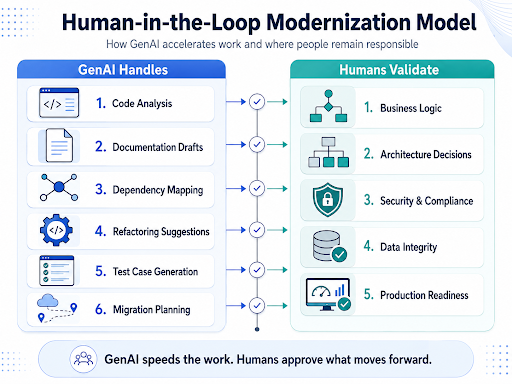
The most practical modernization model is not AI-led. It is AI-assisted and human-validated.
In this model, GenAI handles tasks such as drafting, summarizing, mapping, or suggesting. Engineers and domain experts validate the decisions that affect business performance, compliance, and reliability.
What GenAI Handles
- Code analysis
- Documentation drafts
- Dependency mapping
- Refactoring suggestions
- Test case generation
- Migration planning support
These outputs help teams move faster. They also reduce the amount of time spent on repetitive analysis.
What Humans Validate
- Business logic
- Architecture fit
- Security controls
- Compliance requirements
- Data integrity
- Production readiness
These areas require context, judgment, and accountability. They cannot be delegated fully to AI.
Why This Model Works
The human-in-the-loop model works because it separates acceleration from accountability. This distinction is important because modernization is not just a code conversion exercise. It is an engineering practice tied to business logic, system reliability, compliance, and operational continuity. Even McKinsey’s LegacyX work frames its strongest outcomes around AI agents working with human developers in the loop.
What This Means for the Future of Modernization
The implications for modernization partners and enterprise IT teams are becoming clear. GenAI is turning modernization into an ongoing engineering discipline. But many organizations lack the internal capacity, legacy expertise, AI engineering skills, or governance maturity to manage this shift alone. That is why more enterprises are turning to specialized modernization partners that can combine legacy system knowledge, GenAI-enabled workflows, cloud expertise, and human-in-the-loop controls.
Consequently, modernization projects today are characterized by:
Continuous Investment
When discovery, documentation, and refactoring become faster, teams can address technical debt in smaller cycles instead of waiting for major transformation programs.
This supports better sequencing across the application portfolio. High-risk systems can be assessed earlier, while lower-risk modules can be modernized in controlled phases. Deloitte’s 2025 guidance reflects this shift by framing legacy modernization as a continuous, AI-assisted process rather than a single event.
Faster Discovery
GenAI compresses one of the slowest parts of modernization: understanding the existing system. In many cases, teams can move faster from “what does this do?” to “what should we do with it?”
That shift moves the bottleneck from manual discovery to informed decision-making. Instead of spending months only reconstructing system behavior, teams can spend more time deciding which systems to retain, refactor, replace, or retire.
Engineer-Led Review
As repetitive analysis moves to AI, engineers may spend more time on review, architecture, governance, and release control.
The Wharton-GBK 2025 AI Adoption Report found that 88% of business leaders expect GenAI spending to increase in the next 12 months. But spending alone will not create modernization outcomes. The value comes when AI changes the workflow, not just the toolset. Legacy modernization is one of the clearest examples of that shift, as every AI-assisted output still requires technical review, domain validation, and release discipline.
Stronger Governance
Governance will likely separate successful GenAI-assisted modernization programs from weaker ones. As AI tools enter engineering workflows, organizations need access controls, approval paths, peer reviews, audit trails, rollback plans, and release ownership. The reported AWS Kiro incident shows the risk. Reuters reported a 13-hour AWS disruption involving Kiro, while Amazon attributed the issue to user error and misconfigured access controls.
For legacy modernization, the lesson is clear: speed without control creates exposure. Safe scaling requires least-privilege access, human review, traceable approvals, and clear accountability.
Where GenAI Leaves Modernization Next
GenAI is not making legacy modernization simple. It is making the work more visible, structured, and easier to sequence. Discovery, documentation, refactoring, and testing can now start with AI-generated drafts, summaries, mappings, and test scenarios, rather than fully manual groundwork.
That is the real shift. Legacy software transformation is moving from a slow, episodic exercise toward a continuous, AI-assisted engineering discipline. But the underlying responsibility has not moved. Modernization remains a business-critical engineering decision. GenAI software engineering works best inside mature review processes, where humans remain accountable for business logic, architecture, compliance, and production readiness. It becomes risky when companies treat it as a replacement for those controls.
The question is no longer whether GenAI can support modernization. It is how confidently enterprises can redesign modernization around AI-assisted, human-validated workflows, and how quickly they can build the governance to scale that model safely.
