Commerce Media’s Budget Problem Is Getting Worse. Rokt Has a Different Answer.
The math behind most commerce media strategies doesn’t work the way marketers think it does. Advertising dollars continue flooding into the same few high-visibility channels (search, social, display) while the moments where purchase intent peaks are either ignored or served with generic, low-relevance content that drives nobody to convert.
Ashley Firmstone, SVP of Rokt Ads GTM at Rokt, put a precise frame around this problem in a recent LinkedIn article. Her core argument: commerce media budgets are structurally misaligned, concentrated heavily at the top of the funnel where consumer intent is weakest. And as AI gets layered into campaign planning and media buying, that misalignment could calcify rather than correct.
Her concern is grounded in something observable. AI campaign tools that lack high-quality underlying data will optimize confidently toward the wrong outcomes. “If the pipes are messy, what you’re generating through AI won’t make sense,” Firmstone told The Drum in October 2025. “We’re integrating AI into campaign optimization, but the strategy and storytelling still have to be led by humans.”
That tension sits at the center of what Rokt has built and where the broader commerce media category is now headed.
Where the Budget Goes vs. Where the Intent Is
Marketers know checkout is valuable. The insight isn’t new. But spending patterns have been slow to reflect it.
According to data from Skai’s 2025 State of Retail Media report, over 200 retail media networks are now competing for advertiser dollars, yet sponsored product placements and on-site pre-purchase inventory continue to absorb the majority of those budgets. The post-cart window, which includes the payment page, the confirmation screen, and the brief period after a customer has already committed to buying, remains underinvested relative to the volume of commercial intent passing through it.
This isn’t a small oversight. Rokt’s platform overview notes that the Transaction Moment, spanning cart through confirmation, accounts for over 90% of a brand’s ancillary revenue potential. Every percentage point of engagement improvement inside that window compounds across billions of interactions.
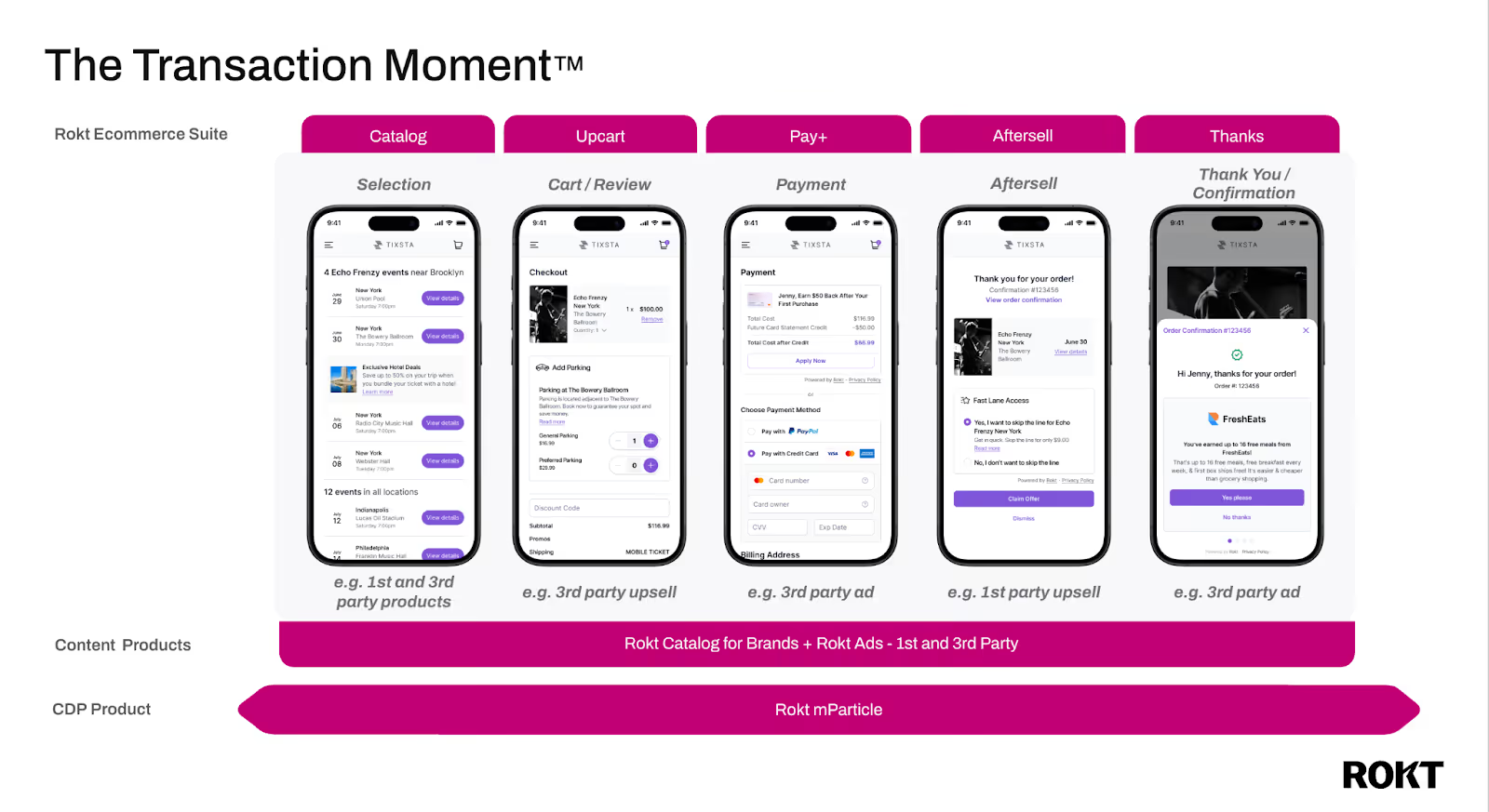
Rokt’s own performance numbers show what’s available. Its Rokt Ads network delivers a 4.03% click-through rate and 6.32% conversion rate globally, which is ten times the CTR of Google Display and four times that of Facebook Ads, per Rokt’s advertiser data. Those figures emerge precisely because the ad is placed at the moment of highest intent, not the moment of lowest resistance.
AI as Multiplier, Not Correction
Firmstone’s argument isn’t that AI makes commerce media worse. It’s that AI amplifies whatever foundation it’s given. Strong first-party data, well-structured by clean infrastructure, will be amplified well. Fragmented, inconsistent, or late-arriving data will produce AI-generated decisions that look confident and perform poorly.
Research published by Madison and Wall in February 2026 puts this dynamic in structural terms: AI-powered ad buying was at 8% of U.S. ad revenue in 2025 and is projected to reach 26% by 2030, or roughly $142 billion. The authors note that AI adoption in commerce and other digital formats is advancing, but that its effectiveness depends entirely on the quality of data feeding those systems.
The clearest statement of this problem at the infrastructure level came from Rokt’s January 2025 acquisition of mParticle, a customer data platform that replaced batch-processing data pipelines with live feeds capable of millisecond decision-making. The move was a direct investment in data infrastructure, not just capability. Where traditional CDPs introduced latency between signal and action, mParticle enables the kind of real-time optimization that AI models need to perform in dynamic checkout environments. Rokt mParticle now offers over 300 native integrations, a data network wide enough to provide the signal diversity that accurate AI models require.
The Transaction Moment: Rokt’s Core Thesis
Rokt built its entire product strategy around a specific conviction: the highest-value moment in the customer journey isn’t the ad that introduced the product. It’s the window after the customer has chosen to buy.
As Rokt’s blog defines it, the transaction moment spans from product selection through purchase confirmation, the brief period when customer attention, trust, and intent are simultaneously at their peak. Rokt’s AI engine, the Rokt Brain, analyzes each transaction in real time to determine the most relevant offer or experience for that specific customer, drawing on 1.95 trillion data points analyzed annually.
This isn’t a theory tested on limited inventory. Rokt’s 2026 figures show the network projecting 10 billion-plus transactions for the year, with 165 million monthly active users globally and 104 million in the United States alone. The client base covers more than 33,000 active partners, including over half of the top 200 global e-commerce companies. Transaction growth on Black Friday 2025 was 30% year over year across the Rokt Network, according to a March 2026 analysis in The Silicon Review.
Those numbers reflect more than scale. They reflect the compounding benefit of a network that gets smarter with every transaction it processes.
The Quality Guardrail Other Platforms Don’t Build
One detail in how Rokt operates distinguishes it from pure-revenue-maximizing approaches to checkout monetization. Rokt’s system will show no offer at all if the minimum relevance threshold cannot be met.
This matters in the context of Firmstone’s budget argument. Commerce media that show irrelevant offers to high-intent customers don’t just underperform. It degrades the customer relationship and erodes the trust that makes the Transaction Moment valuable in the first place. Rokt’s Chief Commercial Officer Elizabeth Buchanan made this explicit in January 2026: “Brands and retailers are recognizing that scale without control leads to saturation, diminishing returns, and frustrated consumers.”
The response to that recognition is a product architecture where relevance enforces itself. Rokt partners keep full ownership of their first-party data and control what categories of offers appear in their checkout experience. The Rokt Brain optimizes within those constraints, not around them. The result, as Firmstone has described the broader principle, is advertising that doesn’t need to feel disruptive to work.
Recognized Growth, Sustained Over a Decade
The strategic case for Rokt’s approach has been validated at the market level. The company posted a 40%-plus compound annual growth rate for over a decade, and achieved 330% growth in the three years ending in 2025. In 2026, Rokt was named to the Financial Times list of the Americas’ Fastest Growing Companies, one of Rokt’s most recent recognition milestones.

The Deloitte Technology Fast 500 recognized Rokt as one of the 243 fastest-growing technology companies in North America in 2025. Partnerships with PayPal, Live Nation, Macy’s, Albertsons, Uber, and Fanatics have followed, with Fanatics (a company generating over $8 billion in annual revenue) notably returning to the Rokt Network in late 2025 after evaluating alternatives. That decision carried a signal beyond the contract value.
The company’s investment posture reflects its growth trajectory. Rokt puts $100 million annually into product development, a commitment visible across recent launches, including Rokt Catalog, Rokt Pay+, Rokt Upcart, and Rokt Thanks, each targeting a specific stage of the transaction moment rather than general digital advertising inventory.
The Commerce Media Shift Rokt Predicted
Rokt’s 2026 annual digital commerce outlook, published in January, described the year’s defining shift as one from volume to precision: away from stuffing checkout flows with generic promotions and toward deliberate, AI-optimized experiences tied to real purchase intent.
The broader industry is catching up to that view. McKinsey projects the U.S. commerce media market will exceed $100 billion by 2027, with the median advertiser now working across six commerce media networks compared to four just a year prior. The fragmentation is real, and it’s accelerating pressure on every network to justify its place in the budget by delivering measurable, incremental outcomes.
Rokt’s answer to that pressure is structural. Rather than competing on inventory volume, it competes on relevance per transaction. Its partnership model returns seven out of every eight dollars of value generated back to the e-commerce partner; an economic structure that makes the network’s growth and the partner’s growth the same problem.
Firmstone’s broader point about AI deserves to sit alongside this architecture. AI will not automatically fix a misaligned commerce media strategy. It will, however, take a well-built one and run with it. Rokt’s combination of clean data infrastructure, real-time intelligence, and a product suite designed explicitly around the highest-intent window in the purchase journey is one of the more fully realized versions of what that looks like in practice.
This article has been published in accordance with Socialnomics‘ disclosure policy.