

Monolith vs Microservices: How Modernization Works (And Who Can Help)
It is no longer a matter of whether to modernize legacy systems; instead, it’s about how to modernize legacy systems strategically. Many companies will be confronted with the decision of keeping their existing applications as monoliths or changing to a microservice architecture, making the debate of monolith vs microservices more relevant than ever. Although monolithic applications may appear easier to manage, modern businesses are increasingly requiring the features of scalability, flexibility, and resiliency that are offered by microservices.
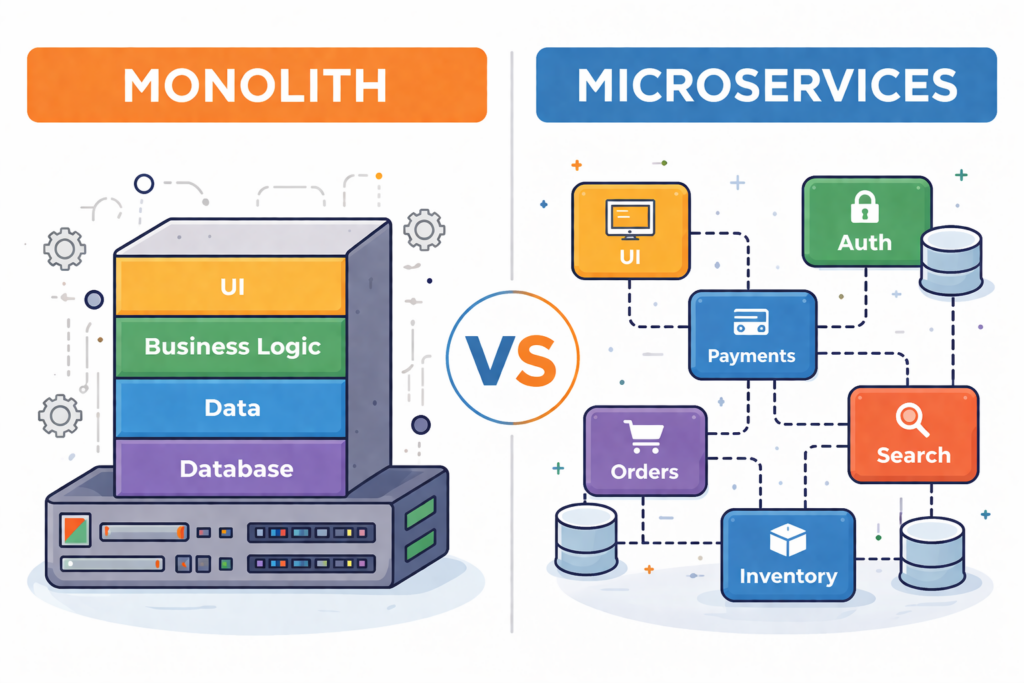
Monolith vs Microservices
Monolithic architecture is made of the whole application at once, front and back together as a complete architecture, but as it grows they become difficult to maintain and scale. Creating a whole new application for a single change comes with increased risk levels and leads to longer development cycles due to the physical code base size of an application.
Microservices will allow the application to be built as small services with independent APIs enabling those services to be developed, deployed, and scaled independently. The isolation of service failures will allow organizations to be innovative at a faster rate than before. As organizations transition away from traditional development methods towards a cloud-native approach, DevOps practices, and Continuous Delivery, a microservices architecture will fit within each of these new methods.
 The process of transitioning to microservice applications usually involves:
– Evaluating the existing monolithic architecture
– Determining service boundaries by identifying bounded contexts
– Gradually tearing out each service with a strangler pattern
– Implementing containerization/orchestration (using Docker and Kubernetes)
– Creating CI/CD pipelines and building out monitoring
Microservices may give long-lasting benefits for organizations, but they can also create new challenges related to services and inconsistencies in service architecture, data and infrastructure management. Because of this many organizations will turn to an experienced technology partner for guidance in the transition.
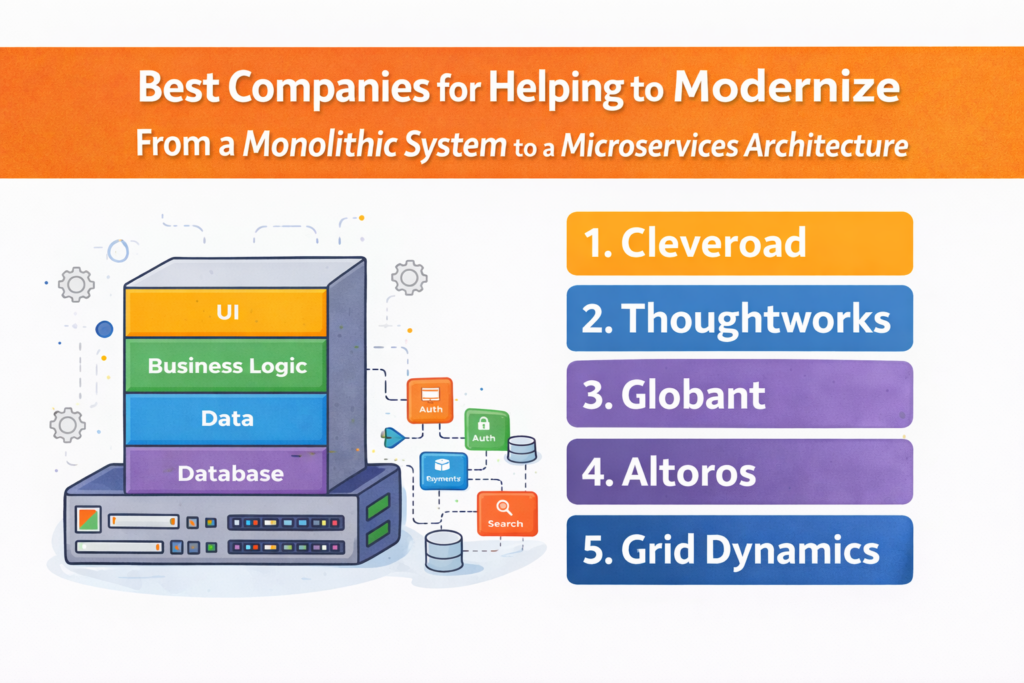
Best Companies for Helping to Modernize From a Monolithic System to a Microservices Architecture
Here is a list of organizations that have been selected because of their success at helping other organizations move from traditional (‘monolithic’) systems to contemporary (‘microservices’) architectures.
 1. Cleveroad
Cleveroad is a legacy software modernization firm that helps update older computer programs to new versions through new ways of organizing computer systems called “microservices”. They do this by using different technologies such as “containerization” and using online services from companies such as “AWS” and “Azure.” The company’s software engineers are very skilled at using different types of technology to help move from one type of system to another faster and easier.
Cleveroad’s clients range from companies providing health care to transportation, and they strive for all their client systems to be prepared to handle more users and continue to work properly for many years to come. The company has an internationally recognized quality management standard (ISO 9001) and an internationally recognized information security management standard (ISO 27001).
2. Thoughtworks
Thoughtworks is a leader in the adoption of microservices, domain-driven design (DDD), and agile methodology implementations. Technical Capabilities Include: Cloud-native Engineering, Event-Driven Architecture, Continuous Delivery Pipelines. Provide strong partnerships in complex Enterprise Agile-modernization initiatives.
Thoughtworks has broad experience across multiple industries – particularly financial services, retail and media, often working with large Enterprises implementing digital transformations. Frequently appear in Forrester Wave reviews. Highly respected within the software engineering community for contributions to best practices in software engineering and open-source communities.
3. Globant
Globant utilizes an advanced level of technology to build their products with a focus on using AI based solutions. In addition to their development capabilities, they also provide strong engineering oversight through their knowledge of tools, such as Kubernetes and Terraform, to offer innovations in building microservices, serverless architectures, and cloud migration. As they work on modernizing legacy platforms, they leverage their teams’ knowledge and experiences.
Globant currently has customers from multiple industries, including media, entertainment, gaming, financial services, and health care. Each of these companies requires custom solutions that will continue to develop and create a more scalable digital ecosystem. Globant has been named in many top company lists, including: being featured in Fortune’s 100 Best Places to Work and receiving positive ratings for client satisfaction from Clutch and other similar online platforms.
4. Altoros
Altoros specializes in assisting companies with their cloud-native development, Kubernetes orchestration, and microservice transformation projects. Their goal is to help organizations take their existing monolithic systems and break them down into smaller components to create a scalable architecture. They have a large technical stack including Cloud Foundry, AWS and a container-based architecture to enable organizations to deploy applications faster and provide improved resilience of the systems they are deploying.
Altoros has extensive experience delivering solutions for multiple customers in fintech, healthcare and IoT industries requiring high availability and performance. Clutch has recognized Altoros as a top-rated company for cloud consulting and they have strong relationships with leading cloud providers.
5. Grid Dynamics
Engineers at Grid Dynamics are experienced in developing and implementing real-time data processed systems, cloud scale technology, development of data driven API ecosystems, and contributing to developing next-generation cloud-enabled application architecture.
Grid Dynamics and their engineers have multiple certifications across a variety of industries (retail/e-commerce/finance) that require engineered solutions capable of scaling up effectively as well as rapidly producing results. Grid Dynamics is a publicly traded company (NASDAQ: GDYN), and has received several notable awards for engineering excellence and enterprise transformation by various institutions.
Final Thoughts
Selecting between monolith vs microservices isn’t only a technical decision – it’s a strategy for your business. Although Monolithic Architectures may still work well with small or stable systems, Microservices help organizations continue to innovate faster, better scale, and stay ahead of ever-changing market conditions. Proven experts in modernization, the companies shown above will help you transition with the least risk and the greatest potential value from your investment.
