

The Role of AI in Risk Detection
AI is pivotal to preventing risks before they affect production. In contrast to the defined best practices based on the application of specific rules or manual reviews, AI tools can examine data history in code repositories, build logs, infrastructure, and production environments. Using pattern recognition and anomaly detection, AI helps identify inconsistencies that may indicate security weaknesses, misconfigurations, or unusual activity.
This strategic process will not only help identify threats upon occurrence, but also predict and avoid them. This boosts DevOps consulting services’ productivity with fewer emergency patches being delivered, fewer disruptions being experienced, and the delivery pipeline is safer. What is obtained is a security process that keeps pace with the application and mitigates emerging threats.
Vulnerability Management with AI
Identification of risks is quite necessary for software development; hence, proper care should be taken in vulnerability management. AI automates vulnerability management by scanning code, dependencies, and infrastructure on a continuous basis to find known and emerging threats. AI systems may be used to evaluate the severity of a vulnerability once identified, the probable potential of exploitation, and even suggest prioritized actions to be taken through remediation.
The integration of an AI threat detection system within the CI/CD pipeline automates patch management, enforces security policies, and allows or prevents risky deployments to proceed. With advancements, AI models can learn better to recognize and respond to threats, as most of these are based on previous cases.
How AI Improves Security in DevOps
Software delivery seems to be much faster nowadays, and it does not allow much time to carry out manual checks on security. AI can bridge this gap by automating processes, detecting threats in real time, and providing a relevant solution to this breach. The following are some of the main areas in which AI-driven DevOps automation makes pipelines more secure:
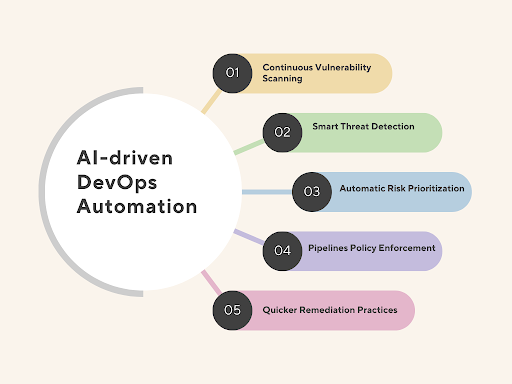
1. Continuous Vulnerability Scanning
Artificial intelligence 24/7 monitors the application code, infrastructure, and configuration. This will make sure that the vulnerabilities are detected as they emerge and not at the designated times when a manual inspection is carried out.
2. Smart Threat Detection
Through logs, traffic, and system activity, AI finds patterns to signal that an attack or suspicious activity may be occurring. Such a heads-up gives teams a chance to act before damage is done.
3. Automatic Risk Prioritization
In other words, AI filters overlapped data related to various sources, including previous attacks and worldwide threat intelligence, to prioritize vulnerabilities by severity and impact. This will help teams address the most important risks first.
4. Pipelines Policy Enforcement
When integrated into CI/CD pipelines, AI can automatically prevent the deployment of risky code, preventing non-compliance with security policy without hindering development.
5. Quicker Remediation Practices
Whenever a high-priority vulnerability is identified, the AI can begin to make changes automatically, patch, or begin a rollback. This cuts down on idle time and exposure.
With these capabilities combined, AI enhances not only the ability to detect but also to respond faster, so that AI-driven risk analysis in DevOps becomes an organic part of the development process, which was earlier a backseat endeavor.
Best Practices for Implementing AI in DevOps Security
The adoption of AI on DevOps security should be strategic and phased. Initiatives should begin with areas that pose high risks converted to AI and then expand their possibilities as time moves on. There must be ongoing updates of AI models in order to stay abreast of the evolving threats and ongoing changes in compliance requirements to achieve lasting security resiliency.
1. Start with High-Risk Areas
The best approach to bringing AI into the world of DevOps security is to concentrate on tackling the systems and procedures with the highest impact in the event of a hack. It may include production environments, sensitive repositories of data, or mission-critical applications. Such areas of targeting would help reduce the maximum risks of adoption at the initial stages.
2. Train AI Models with Relevant Historical Data
When AI learns directly based on the incident history of the organization, codebase patterns, and infrastructure settings, the outcome becomes really effective. When feeding models with precision and context-proven historical data, the model will have a higher chance of picking up threats and minimizing false positives.
3. Keep Human Oversight for Critical Decisions
AI-powered DevOps may automate the detection and response, but human expertise is still crucial to ensure the interpretation of the ambiguity of identified risks and provide the final security determinations. The combination of both promotes the idea that AI facilitates the process with the validation and monitoring of essential steps by security experts. Organizations that hire AI developers can better integrate these capabilities, ensuring that automation and human judgment work hand in hand for stronger security outcomes.
4. Regularly Upgrade the AI Model to Manage Threats
Cyber threats do not remain constant, and the targets set by static AI models become ineffective very soon. Retraining and continually updating AI algorithms using new data will keep them current with regard to the most recent attack vectors, vulnerabilities, and compliance mandates.
Concluding Thoughts
Security checks and vulnerability management can’t be a secondary consideration anymore when it comes to software delivery. AI can be integrated for DevOps automation to help businesses match their security pace to their development pace, minimize the risk of exposure, and stay in regulatory compliance. The AI will save an organization time in terms of improving its security without slowing down the delivery. This means that AI is becoming part of operational requirements and no longer a futuristic consideration.
With regulations becoming stricter and cyber threats becoming increasingly sophisticated, the resilience of a given organization will be determined by its capacity to predict and preempt threats using application security tools. AI offers the means to make this a reality; in that regard, changing security into something proactive, along with software development.
