

AI-Assisted Software Development: What It Actually Changes in 2026
AI has more than just a “write code quicker” effect. Its impact is much more extensive; AI has an impact up to and including how a team identifies their ideas into specifications or requirements; the way that developers work with code; their actions while doing quality assurance and how companies increase their productivity. However, it will not eliminate the need for seasoned engineers, sound architecture and security principles, and human intuition. What is going to be changed due to AI-assisted software development by 2026?
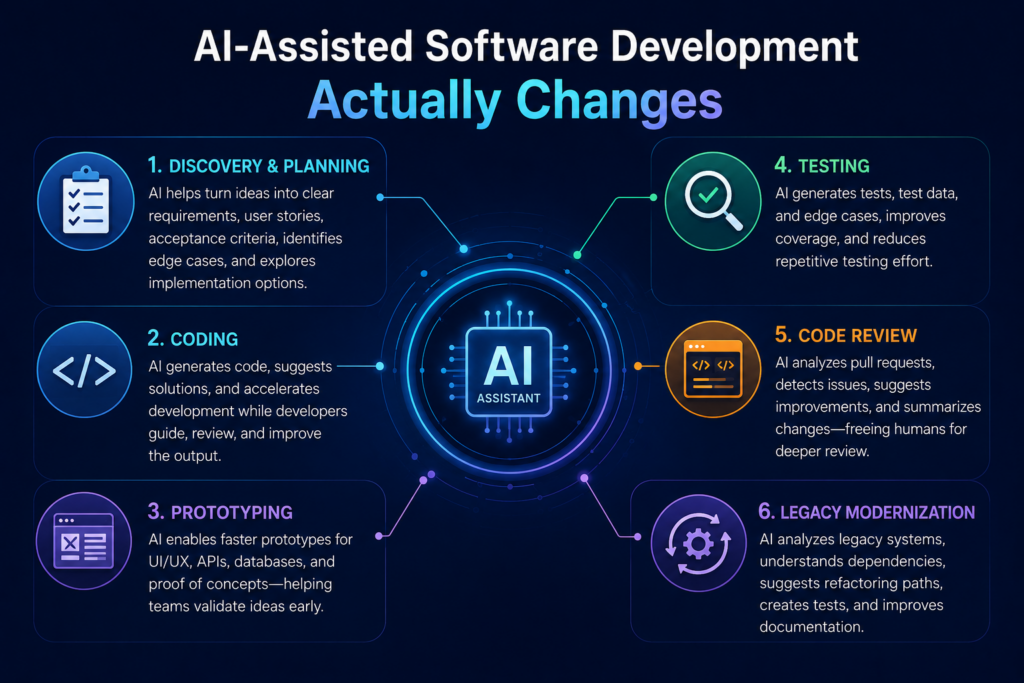
AI revolutionizes the discovery and planning stage
During the discovery phase – before development starts – all involved parties need to clearly understand both what they are developing and why they are doing so. Traditionally, this has required stakeholders to conduct interviews, document product requirements, write user stories, have technical discussions, and estimate time and resources for each project.
AI-assisted software development can provide assistance to individuals involved in the project’s development, such as product owners, business analysts, and development teams, by converting loosely defined concepts into clearly defined requirements. Examples of how AI can support this activity include assisting stakeholders in generating user stories, defining acceptance criteria, identifying edge cases that may have been omitted, preparing questions for stakeholders, and performing a comparative analysis of potential implementation paths.
This is extremely valuable when organizations only have a vague idea of what they are trying to accomplish (e.g. “create a dashboard that uses AI to simulate user performance” or “provide AI-based solutions for customer service”). Help from AI can assist in transforming these high-level concepts into specific issues such as: What data will the system utilize? What demographic or group will be using the system? What workflows will be automated? What risks should be taken into account?
AI does not take the place of conducting product discovery. There are several factors that AI has no ability or capability to perceive or evaluate without human input, including business goals, user behavior, market positioning, and regulations. The primary benefit of using AI is that it expedites the process of moving from an empty canvas to a more focused conversation.
AI-assisted software development modifies the way developers develop code
One of the biggest areas of change is code generation. Developers can use AI-based tools to create boilerplate code, generate method signatures, explain application programming interfaces (APIs), construct SQLs or similar functions for a database, and produce basic components of applications.
What is perhaps more noteworthy is that the role of the developer has shifted as well. In an AI-enabled workflow, developers are no longer writing code line by line; they are playing a large role in guiding, inspecting, correcting, and improving AI-generated code.
For example, a developer can describe a feature, request an AI-generated prototype, inspect it to ensure it conforms to the architectural standards of the project, add necessary validations, improve performance, and author tests. The workflow enables developers to complete routine activities much faster and at a lower cost as a result of AI usage.
However, it is important to note that code generated by AI is not a production-ready solution without the insight of an experienced developer. AI-generated code may have security flaws or inadequate error handling, excessive complexity, or design patterns inconsistent with the project’s existing design. Thus, the overall importance of an experienced developer and their judgment about whether the generated output meets the requirements should be even greater in 2026 than at present.
AI improves prototype development speed
Rapid prototype generation is achieved thanks to AI-assisted software development. Teams can make drafts for UI/UX designs, APIs (application programming interfaces), back-end data structures/schema, and create prototypes of proof of concept at a very low cost.
This is especially true for new companies, as a founder can quickly produce a demonstration of their product; therefore, validating their business idea early on in the process. For larger organizations, an internal development team can evaluate new service offerings, or validate potential reduced cost/service efficiencies offered by automating their business processes, prior to investing large amounts of resources to develop those services.
However, fast-generated prototype applications may have issues with architecture, scalability, security, or testing. Therefore, organizations should be aware of the difference between an AI-generated prototype application and a product-ready software application.
While AI-assisted software development allows cross-functional teams to generate lots of prototypes and/or demonstrations quickly, it does not eliminate the engineering work required to create a reliable software application.
AI changes software testing
Software testing is one of the most qualified application areas for the use of AI-based development technology. AI provides support for generating unit tests, suggesting integration test scenarios, creating test data, identifying edge cases, and explaining why tests fail for both developers and QA (quality assurance) engineers.
It can improve the overall test coverage and reduce the workload of repetitive tasks for QA teams. Many developers are not inclined to write unit tests when pressed for time, but now they will have a good starting point to work from with the help of AI.
However, tests generated by AI still require review; often, they are merely verifying that the latest version of the code functions correctly, not that it provides a solution to the right problem. Additionally, it is possible that AI will not capture all business-specific scenarios while generating test cases because of incorrect assumptions about the business and its rules.
The most productive way for teams to use AI for testing will not be from automated testing blindly. Instead, it will support the QA Engineer and developer team to define what “quality” means from the perspective of their customers.
The code review process is changing through AI
AI-assisted software development is also changing the code review process. With advancements in AI, it is able to examine pull requests, summarize changes, detect duplicate code, identify potential performance improvements, and identify potential security flaws in code all before a human reviewer looks at it.
This will free up time for human reviewers to focus on things like architecture, business logic, maintainability, and system design instead of reviewing every detail of the code.
While AI can be used as part of the code review process, it should never be used as the final reviewer in code review processes. Finding syntax errors and obvious bugs is just one part of the code review process; it is also about determining if a certain solution is appropriate for the product, user needs, and the long-term viability of the entire system.
AI can perform a first-pass review of the code being reviewed; however, it is up to senior engineers to make the final technical decision regarding the code that was reviewed by the AI.
AI-assisted software development changes legacy software modernization
Many large companies are using antiquated systems that are poorly documented and built using outdated technology. AI can assist teams in modernizing these legacy systems by providing insight into their architecture, providing an overview of all dependencies on a given piece of code, advising on best options to refactor, creating missing unit tests, and documenting any undocumented modules.
This aids teams in modernizing legacy applications by giving them tools to analyze existing systems more quickly and allowing them to create migration/refactoring plans with greater context.
However, legacy modernization is still a complex problem. Many legacy systems contain business-critical logic that may not be obvious by simply reading through the code. While AI provides teams with an understanding of the existing architecture, engineers are required to validate all significant changes to ensure that they do not interfere with critical system workflows.
What AI does not change
The fundamentals of software engineering do not change due to AI-assisted software development. Companies continue to require clear product strategies, dependable architectural designs, secure coding methods, thorough testing, and knowledgeable technological leadership.
Poor specifications will yield poor results no matter how much AI helps develop a project. Architecture problems will create technical debt no matter how much AI aids the development process. Unreviewed code will create bugs and security vulnerabilities regardless of how much assistance AI offers. Therefore, while AI may assist in speeding the software development cycle, it will also speed up mistakes made by an uncareful application of AI by teams.

Final Thoughts
AI-assisted software development is altering nearly every aspect of the software development lifecycle by 2026. AI will help teams to do things such as plan faster, prototype quicker and develop code more efficiently, provide better test coverage, provide support for code review, generate documentation and modernise legacy systems.
The most profound impact of AI-assisted development will not be that developers will be replaced, but rather that the way developers work will be transformed. Developers will be focusing less on creating code manually and more on utilizing AI-enabled tools to assist them with creating code, reviewing output from AI-enabled tools, overcoming complex tasks and making architectural decisions.
Companies that consider AI to be an easy solution will likely be left with fragile applications that are poorly maintained. However, companies that combine AI-enabled speed with strong engineering principles can create a true competitive advantage.
AI-assisted software development is not going to end software engineering; in fact, it is entering into another phase in which good software engineering will become increasingly important.
