

Machine Learning in Retail: 10 Powerful Use Cases
Understanding consumers and providing the appropriate items at the right time have always been key components of retail. This has advanced from intuition to accuracy based on data, thanks to Machine Learning (ML). Machine learning is changing how retail firms function, from forecasting what customers will purchase next to optimizing supply chains. Let’s examine five compelling use examples of machine learning in retail that demonstrate how this technology is revolutionizing the industry.
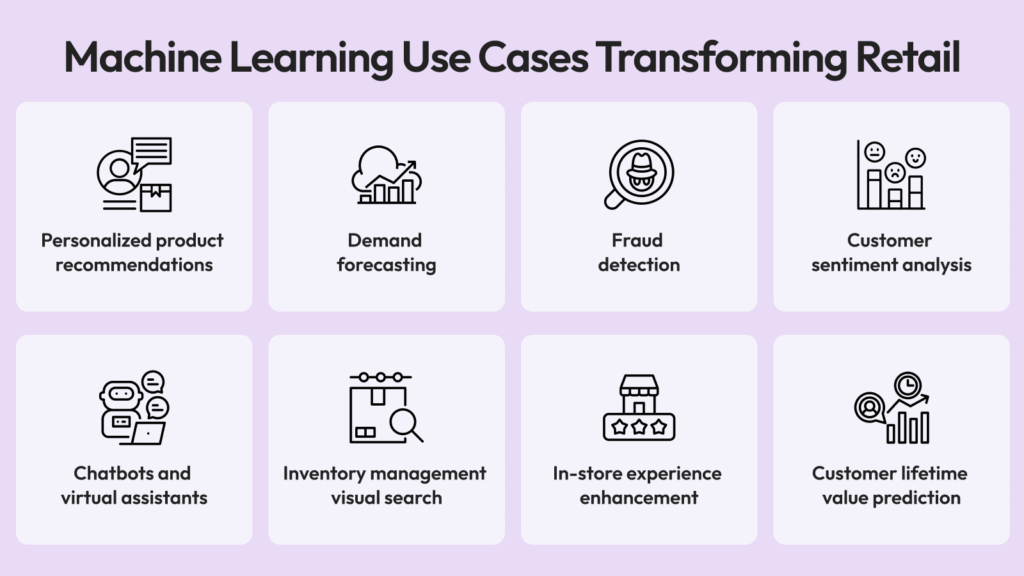
Personalized Product Recommendations
The “You may also like” option is frequently shockingly accurate when you order online. That is the application of machine learning in retail. Algorithms make personalized product recommendations by examining browser history, purchasing trends, and even the amount of time spent on particular product pages. Customers feel understood, which enhances the whole shopping experience in addition to increasing sales. One prominent example is Amazon’s recommendation engine, which contributes significantly to the company’s earnings.
Demand Forecasting
One of the most difficult problems facing retailers is getting inventory properly. If you stock too little, you lose sales. If you stock too much, you squander resources. To more precisely forecast demand, machine learning algorithms examine past sales, seasonal patterns, regional events, and even meteorological data. To ensure that shelves are supplied without overordering, grocery retailers, for example, employ these algorithms in inventory software development to predict surges in demand for certain commodities around holidays.
Fraud Detection
Transactions over the internet, especially, have the risk of deceit. To detect unusual buying behavior like sudden large orders, unaligned shipment sites, or dubious modes of payment, machine learning techniques scrutinize vast quantities of data. Stores quickly discover these abnormal situations and avoid monetary losses for their customers and themselves. The use of such models is indispensable for online selling sites and money transfer companies in their fight against con artists.
Customer Sentiment Analysis
The opinions of the customers regarding your brand are as important as the things they buy. The process of machine learning can go through and analyze social media posts, reviews, and customer feedback to show the positive or negative sentiment overall. For example, if a clothing company sees a sudden increase in negative remarks about the quality of its fabrics, it can take measures to solve the problem before it gets too big. Such a high degree of instant insight not only helps merchants to avoid possible risks to their reputation but also to make ties with customers even more solid.
Chatbots and Virtual Assistants
Retail chatbots of today are not limited to mere FAQ inquiries and responses. They are equipped with the capability provided by Natural Language Processing to comprehend customer inquiries and offer individualized solutions according to customers’ needs, like order tracking, outfit pairing, or laptop recommending based on preferences. One of the ways a Sephora virtual assistant, for instance, has positively supplemented customer interactions by recommending the right makeup for each customer’s skin and style has simultaneously further reduced the human staff’s work and stress.
Inventory Management and Supply Chain Optimization
Demand prediction is only one of the many benefits that machine learning can bring to the supply chain; it also enhances the chain’s overall efficiency. Retailers rely on algorithms to regulate their restocking schedules, select the most efficient shipping routes, and even foresee delays that could occur. To illustrate, Walmart applies machine learning in retail as a tool to optimize its enormous logistics network, and hence, products are transported to stores quickly and at the same time with less operational cost. The retailer not only receives this advantage but also ensures that the customers will not miss their needed items when they want them.
Visual Search and Product Discovery
Gradually, shoppers are showing more preference towards searching through images instead of using words. With visual search tools, the customer can submit a picture and right away find items that are like the one in the photo. The technology is being adopted by fashion and home décor shops to the extent that they call it a customer service for discovering one’s own taste through the uploading of photos instead of needing the accurate description of a product. One of the legendary tools that became popular is Pinterest Lens, which lets people find items by taking a picture of them.
In-Store Experience Enhancement
ML is not just a thing of the past but also a present-day benefit to physical stores. Smart cameras, along with sensors, are being used to track customer movements, which will help in knowing the shopping patterns precisely, optimizing the store layout accordingly, and finally reducing the time at the checkout. A few retailers have started using computer vision to set up cashier-less stores in which customers can enter, take items, and exit with the payment done automatically. One good example is Amazon Go, which is giving a smooth in-store shopping experience.
Customer Lifetime Value Prediction
Every customer is different. One-time shoppers do exist, but on the other hand, there are also customers who turn into loyal fans and stay with the brand. By looking at the frequency of purchases, spending habits, and level of customer interaction, machine learning predicts and provides the lifetime value of a customer to retailers. So using this information, companies can direct marketing campaigns to the most valuable customers, giving them exclusive rewards or personalized deals in order to bond with them even more. The same approach is being used by subscription-based services to find out which customers are most likely to renew, and then target those who may need a little extra push with incentives.
Price Optimization
The utilization of ML has transformed retail pricing into a science. The optimum pricing strategies are recommended by algorithms that take into consideration not only competitor prices and market situations but also customer demand and historical sales data. Dynamic pricing is already in practice among airlines and ride-hailing services like Uber. Retailers are also employing the same tactics, changing prices instantly to ensure the highest possible profit and customer contentment at the same time.
Final Thoughts
Machine learning has become a usual part of technologies in retail today. It has already become a part of the common shopping experience. These technologies, from cashier-less shops to personalized recommendations, are making retail operations more efficient, intelligent, and profitable. By implementing machine learning in retail, which is not just a matter of being competitive, companies can redefine their customer relationships in an industry that is rapidly changing.
