

Generative AI for Lean Startups: How Entrepreneurs Are Building Smarter in 2026
Startups are evolving thanks in part to Generative AI for Lean Startups, which allows them to be built, launched, and scaled much faster than in years past. AI enables founders to conduct research, develop products, market their companies, sell their products or services, provide customer support, and operate their businesses more efficiently than ever before while avoiding the expense of hiring large teams immediately.
Of course, these developments don’t eliminate the fundamentals of building and running a successful startup; founders must have a defined problem to solve, obtain legitimate customer feedback, establish strong positioning in their marketplace, and demonstrate disciplined execution. Generative AI will help start-up founders complete the journey from having an idea to having a product in hand at lightning speed.
Generative AI Complements the Lean Startup Approach
The Lean Startup model is about quickly validating a business idea through the creation of a Minimum Viable Product (MVP), testing that MVP with real users, learning from those user interactions, and making improvements quickly. Generative AI can help with each of those phases by significantly reducing the amount of manual work.
Using AI, founders can generate customer interview questions, conduct competitive analysis, summarize competitors, write copy for landing pages, draft pitch deck outlines, create user stories, and prototype product flows. This enables small teams to test and validate multiple business concepts before investing a lot of time and money in one.
Building your Minimum Viable Product (MVP) Faster With Fewer People
Many successful startup companies use AI-assisted tools to help them produce their software code, produce related documentation, create any test cases, and build their initial product architecture. Also, AI-assisted, no-code & low-code platforms enable non-technical founders to quickly design a prototype before they hire a full engineering team.
By focusing on just one core workflow at a time (for example, onboarding, booking, recommendations, and so forth), a founder can create a smaller MVP (Minimum Viable Product) than they would if they spent long in developing an entire platform and instead focus on building, testing, and iterating improvements to the platform based on actual user feedback after they have launched their MVP.
However, the challenge for most founders is to figure out how much generative AI to build into their product. As a software development company specializing in generative AI development services, companies like Cleveroad can help with this growth phase by creating AI-powered assistants, chatbots, integrations with LLMs, RAG-based systems, and AI-enabled business platforms. For lean startups, these types of partnerships can be very helpful when the company’s idea moves beyond the early experiment phase and needs secure architecture, systems integration, and ready-to-use AI to get the built product to market.
Improving Customer Discovery/Validation Using Generative AI for Lean Startups
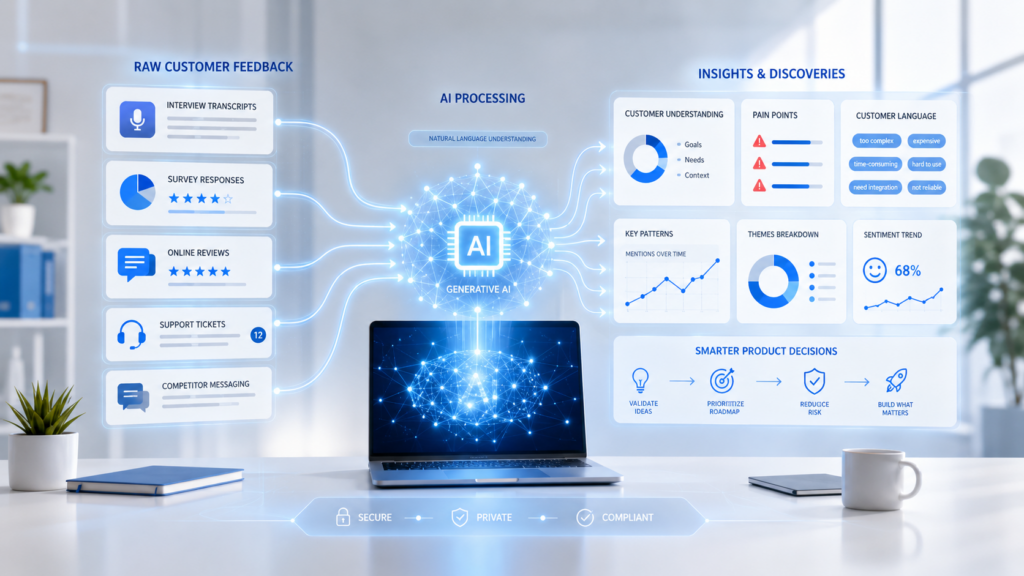
Generative AI can help entrepreneurs analyze their customer and market data more quickly than ever before. For example, startups can use AI to analyze interview transcripts, survey responses, online reviews, support tickets, and competitor messaging to identify patterns of recurring pain, objections that consumers frequently mention, and language that consumers use to describe their problems.
While these insights will need further validation through actual user interviews, the use of AI-generated data will allow startups to create better hypotheses and make more informed product decisions sooner in their development cycles.
Startups Using AI Agents to Automate Their Workflows
AI agents help startups automate tedious repetitive workflows, such as qualifying leads, summarizing meetings, drafting follow-up emails, monitoring competitors, updating CRMs, organizing support tickets, and preparing internal reports.
For teams in the early stages, this will create fewer operational bottlenecks. While these agents do not make human decisions, they will allow founders to spend less time performing routine tasks and more time working on products, customers, and growth.
Using Generative AI, Startups Can Test Marketing & Sales Faster
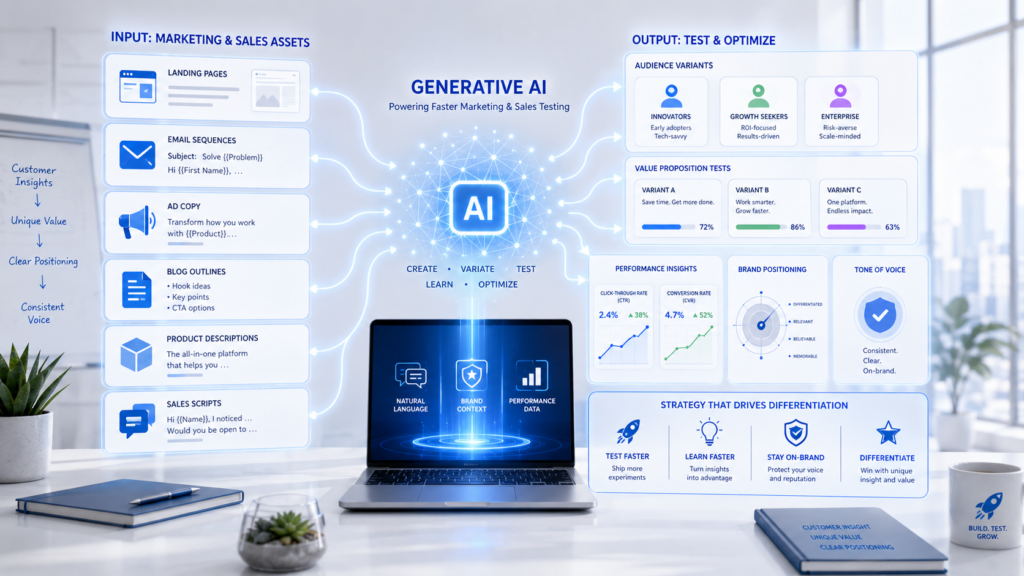
Startups can create and test marketing assets more efficiently than ever before thanks to generative AI. Founders use generative AI to test landing pages, email sequences, ad copy, blog outlines, product descriptions, and sales scripts.
Using Generative AI for lean startups makes it easier to try different types of customers and test out new value propositions. However, AI-generated content has become so prevalent that startups will continue to need unique insight into their products and services, well-defined brand positioning, and a consistent tone of voice to differentiate themselves.
Increasing Numbers of Vertical AI Startups
Numerous business founders are leveraging Generative AI for lean startups to develop industry-specific applications. A logistics company would create an AI assistant to monitor delivery delays, a finance company would automate the review of documents, and a health care business would generate summaries of patient intake forms based on their profile data. Education is another example where an AI-based learning system would make recommendations for appropriate courses based on online performance level.
Vertical AI applications are more effective at solving specific job function issues and may be modified for specific industries; therefore, vertical AI applications offer greater value than general-purpose applications because they address actual industry requirements, including historical data, regulations, and connections with established systems.
Cost of AI Will Go Down but Complexity Will Not
While generative artificial intelligence enables startups to run a leaner model, AI can’t solve every challenge in a startup. Startups will continue to need to manage the costs of the different models they may use, data security, data privacy, compliance, accuracy, and user trust.
Startups that are successful will have a clear question to answer at the beginning of their process: does AI make any operation at their company faster, less expensive, easier, or change the accuracy of their deliverable? If you have that answer, then the use of generative AI for lean startups will be valuable. If not, you are probably adding a technology company without having identified or solved a meaningful problem for your customer.
Final Thoughts
Thanks to the positive impacts of Generative AI for Lean Startups, small businesses/start-ups are becoming more innovative and functional by utilizing fewer resources and more optimized processes in their marketing strategy, operations, and developing new products more quickly.
