Oscars 2025: The Brutalist’s Use of AI
In the annual Oscars award show on Sunday, many stars walked the red carpet and were honored for their contributions to the top nominated films. Certain films, actors, and producers were heavily predicted to win an Oscar, but the academy surprised the world with other winners.
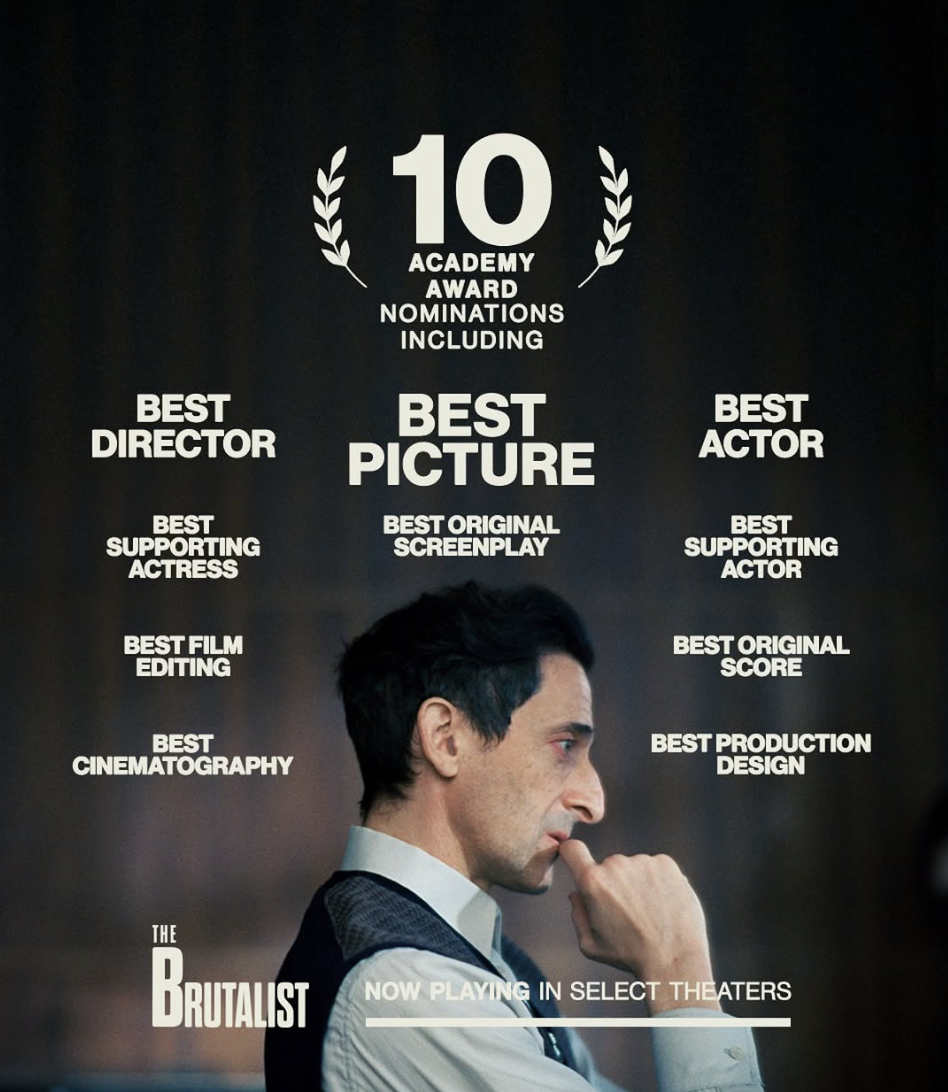
One film in particular that was destined to win more than it accomplished was The Brutalist, directed by Brady Corbet. The movie received 10 Academy Award nominations and ended up taking home three awards: Best Actor, Best Cinematography and Best Film Score.
Some believe that the reason for The Brutalist’s underperformance at the Oscars was because of the use of generative artificial intelligence in the film.
Below, we answer some of the most pressing questions about The Brutalist’s use of AI and how they are dealing with its backlash.
Respeecher Assisting Accents
In an interview with Redshark News, Dávid Jancsó, the main editor, revealed that the team used a Ukrainian software company to make the actors Felicity Jones and Adrien Brody sound authentically Hungarian.
The company, called Respeecher, specializes in voice-changing technology that involves AI. Jancsó can speak in native Hungarian and said that he replaced some of Jones and Brody’s words in the solely Hungarian scenes to perfect the sound.
The actors spent most of the film talking in English with a Hungarian accent, but the editors wanted to make any necessary changes to their pure Hungarian dialect.
“Most of their Hungarian dialogue has a part of me talking in there,” Jancsó said to RedShark News.
Rendering of Buildings
Jancsó also said to Redshark News that The Brutalist used partial AI-generation to show blueprints and buildings that the fictional architect, László Tóth, designed.
This received a negative response because the movie was up against other Oscar-nominated films that did not use any alterations to visual elements.
The producers had a limited budget of under $10 million for the film and said that the use of AI was helpful in saving money and making the post production work more efficient.
Response to the Backlash
In response to the gossip about AI, Corbet released a statement that clarified and debunked the public’s concerns.
Corbet said that the actors, Jones and Brody, worked with a dialect coach for months before they filmed to perfect their Hungarian accent.
He does admit, however, that little use of Respeecher AI was added to the Hungarian language dialogue to make it sound more realistic. Corbet wanted to make it clear that this process was carefully done and was only used in essential places.
Corbet also responded to the rendering of blueprints and buildings in the film. He noted how the production designer, Judy Becker, and her team hand-drew buildings for the movie. He stated further that the team designed some buildings in background shots with the specific intent of making them look rendered and from 1980.
AI and The Oscars
The Brutalist wasn’t the only film that received controversy after its discussion on AI. While some production teams support the benefits of integrating AI technology to small details in films, some think that any amount of AI is unjust and takes away from the raw cinematography.
The future for AI in filmmaking remains uncertain, but its increasing presence in Hollywood is sure to raise new ethical questions and change the industry’s view of technology.