

AI in Recruitment from Sourcing to Onboarding
Hiring used to be a game based on speed, accuracy, and people skills as well. However, artificial intelligence is rewriting the rules today. Right from the time the job gets listed to the time a new employee shows up in the workplace (or logs in online), AI is stealthily redefining each stage of the hiring process. Let’s dive into the way this is occurring and why AI in recruitment is transforming the future of hiring.
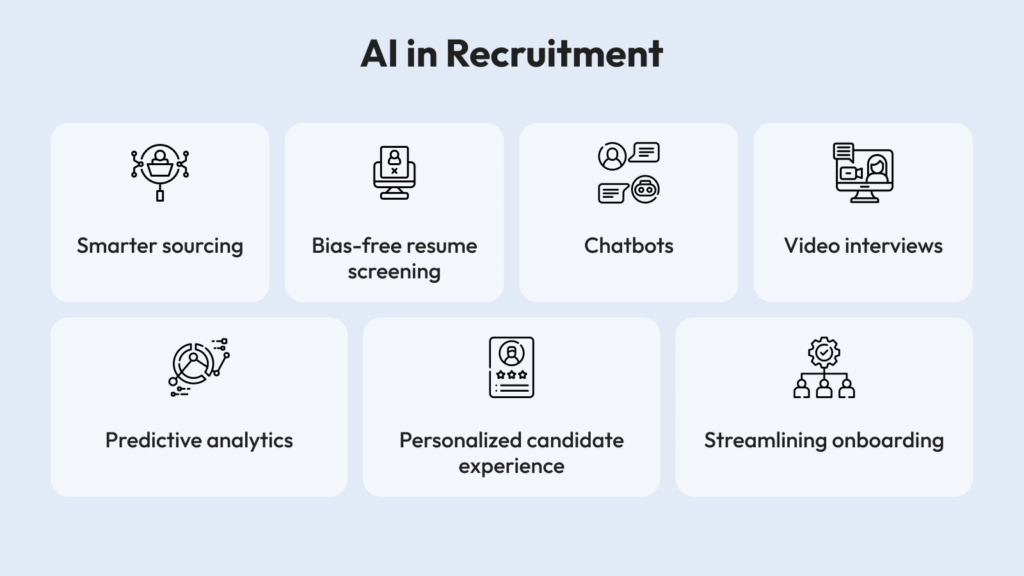 Smarter Sourcing: Acquiring the Right Talent Quickly
Days are over when recruiters used to screen through heaps of resumes or scroll through LinkedIn for hours. Sourcing tools based on artificial intelligence can screen millions of profiles and resumes in a matter of seconds and identify the matching ones with startling precision. Use Entelo or HireEZ. Both sites look beyond resumes and examine online behavior, entire networks, and current activity to figure out who is actually searching for a new job. That means recruiters can target candidates before the competition is even aware they are available. For difficult-to-staff job openings, such as those requiring data scientists or cybersecurity specialists, this type of precision sourcing is pure gold. It reduces time-to-hire, decreases cost per hire, and identifies candidates who wouldn’t have otherwise applied.
Resume Screening Bias-Free and Lightning-Fast
It takes recruiters almost 23 hours to screen resumes for one hire alone. AI does it in minutes. Platforms such as Ideal and Pymetrics screen through thousands of resumes through the use of natural language processing. They extract experience, skills, and qualifications and rank candidates according to the fit for the role. Certain platforms remove identifiers such as names or pictures from the resumes in order to assist in eliminating unconscious bias. One worldwide retail brand utilized AI in recruitment to screen more than 250,000 candidates in a year alone. The system indicated first-tier candidates while enabling human recruiters to make the final choice. The outcome? A 75 percent decrease in the time-to-hire without sacrificing quality.
Chatbots: Engaging Candidates 24/7
No candidates want to wait three days to hear back from you. And recruiters don’t always have time to answer each and every query immediately. AI chatbots such as Olivia from Paradox or Mya fill this gap perfectly. They respond to FAQs, schedule interviews, and notify candidates around the clock. A logistics firm utilized an automated chatbot during the holiday rush-driven hiring surge. The bot responded to questions, guided candidates through the application process, and booked interviews without any human intervention. The firm hired 80 percent of the openings in half the time it would have taken otherwise. A win-win situation: candidates are assisted, and recruiters get to focus on strategy.
Video Interviews: Assessing Soft Skills Using AI
Traditional interviews are hit-or-miss at times, particularly when attempting to assess communication skills or cultural fit. Enter video interviews aided by artificial intelligence. Applications such as HireVue or Modern Hire examine more than the words a candidate uses. They consider tone of voice, facial expressions, and even body language. All this can anticipate a candidate’s chances of succeeding in a position.
One financial services company used AI-based interviews to screen early-career candidates’ problem-solving and communication skills. The system looked at attributes predictive of success in past hires and indicated the top candidates, of whom many would have otherwise been excluded based solely on their resumes. It is not about replacing human beings but supplementing decision-making with data.
Predictive Analytics in the Workplace
AI doesn’t merely instruct you as to whom you should employ. It can actually forecast the chances of a candidate’s success. Using AI development services, you can build a predictive platform that analyzes historical employee hiring data, employee performance measures, and behavior attributes to predict future performance. This decreases turnover through the identification of candidates who are more likely to remain and excel. A call center employed this strategy and achieved a 30% increase in retention rates. The model indicated which behaviors were tied to job longevity and prioritized them in hiring, resilience, empathy, and ability to adapt, for example, like having a crystal ball when it comes to talent management.
Personalized Candidate Experience
AI fuels a hyper-personalised hiring experience. If a candidate applies and does not get the job, rather than a standard rejection notice, the AI system can automatically propose other available jobs suited to their skillset and interests.
Some systems even provide customized career paths to enable the candidates to become qualified for future jobs. That’s what Unilever and IBM are doing. They engage rejected candidates using AI and turn them into potential new hires or even potential customers in the future. It is recruitment with foresight.
Streamlining Onboarding
Employment does not end when the contract is executed. AI in recruitment can facilitate more seamless and engaging onboarding, particularly in remote or distributed environments. Talmundo and Click Boarding are two examples of platforms using AI to streamline paperwork, walk new hires through regulatory tasks, and deliver customized training materials.
One company used artificial intelligence to create customized onboarding sequences based on job position. New engineers learned different things from marketers. Everyone received personalized nudges and reminders based on their progress, so the first weeks felt more like a path than a checklist. The outcome: increased engagement and more rapid ramp-up times.
Answering the Bias Question
AI is no more impartial than the sources it is trained on. Whether hiring choices in the past have been unfair can result in those prejudices being incorporated into the algorithm. Transparency and human intervention are therefore essential.
Forward-thinking firms are utilizing explainable AI, where the system identifies the reasons behind the choices being made. Others periodically stress-test their models in order to detect and eliminate bias. Here, AI is not replacing the recruiters but providing them with enhanced tools to make more equitable choices.
AI in Recruitment: Better Together
Others worry about the prospect of AI replacing recruiters entirely. But the situation is more symbiotic. AI does the routine, data-intensive work. It sorts through resumes, coordinates interviews, and calculates analytics. Recruiters are then able to do what they do best: foster relationships, understand team dynamics, and vouch for candidates. Consider AI as the engine and recruiters as the drivers. They work hand-in-hand to build a more efficient, equitable, and humane hiring process.
Future Direction
The recruitment landscape is rapidly transforming. The more mature the AI gets, the more we can anticipate deeper customization, more intelligent predictions, and more diverse hiring processes.
Imagine a world where hiring is predictive rather than reactive. Where candidates are mapped to jobs not only based on skill but also on values, potential to grow, and fit with the team. And where each applicant, regardless of being hired or rejected, leaves feeling respected. That’s the promise of AI in recruitment, not to replace humans, but to help us hire better, faster, and more fairly.
