

The Future of Shopify Growth Lies in AI-Driven Personalization and Retention
In today’s hyper-competitive eCommerce cycle, acquisition has lost its strategic advantage. Shopify brands are realizing that pouring budget into ads only creates shallow spikes in traffic—not sustainable revenue. What drives true business growth now is retention as an operating strategy, not a marketing function.
Customer acquisition costs (CAC) have surged 3–5x across most digital channels. At the same time, retention-driven profitability continues to outpace acquisition-focused models. Bain & Company’s analysis reveals that a modest 5% uplift in retention can increase profitability by up to 95%—but the nuance most brands miss is why. Retention strengthens compounding revenue loops, reduces dependency on volatile ad platforms, and stabilizes forecasting models.
For Shopify merchants, retention is no longer about post-purchase emails or loyalty programs. It’s about constructing an AI-powered predictive engagement ecosystem—one that interprets intent, identifies behavioral triggers, and proactively meets customer needs before they explicitly express them. This evolution marks the shift from reactive retention to predictive retention intelligence.
How Retention Defines Shopify Store Success
Shopify’s growth model has fundamentally shifted from “more traffic = more revenue” to an experience-based profitability approach. The modern eCommerce landscape is no longer a transactional storefront but a continuous digital relationship engine where every micro-interaction influences customer lifetime value.
Today’s consumers don’t just expect personalization; they expect recognition, anticipation, and continuity. They engage with brands across multiple devices, channels, and sessions, ensuring each touchpoint feels intelligently connected. This shift marks the rise of experiential commerce, where emotional resonance and contextual relevance drive higher margins than acquisition-heavy tactics.
The Evolution Toward Predictive Personalization
The next transformation wave for Shopify merchants is AI-driven personalization for eCommerce, a system where the store dynamically adapts based on:
- Behavioral patterns: session frequency, dwell time, product affinity
- Intent signals: search patterns, return visits, checkout behavior
- Emotional cues: discount sensitivity, urgency response, friction indicators
Instead of reacting to customer actions, AI-powered stores learn from them, forecast future behaviors, and adjust interfaces, recommendations, and offers in real time.
Data Architecture & Customer Intelligence: Key Contributor to Retention
True personalization begins with unified data. The majority of Shopify stores work with data collected from diverse sources, such as marketing platforms, CRM systems, and analytics reports, each of which contains some customer data.
The customer retention Shopify model begins with centralizing this data into a single customer window. Companies can analyze purchase frequency, browsing, and drop-off areas, use ML and predictive analytics to assess churn, and re-engage customers.
This implies creating a compliant and scalable data pipeline by integrating AI development services with Shopify APIs and data platforms. This whole process drives personalization with authority and responsibility.
AI-Driven Personalization in the Shopify Ecosystem
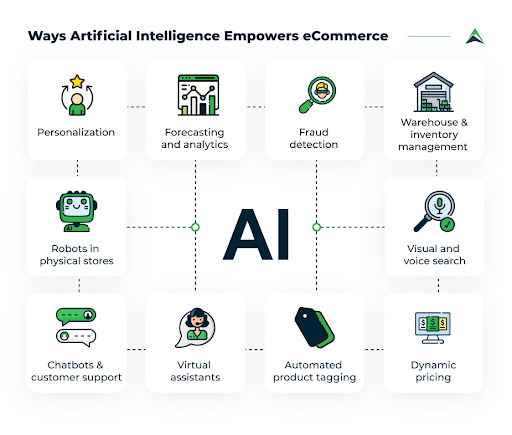
AI has transformed the concept of personalization, which was earlier rule-based, into predictive engagement. The current state of AI-powered personalization on Shopify applications uses machine learning to suggest products in real time, optimize discounts, and even design complete store interfaces.
Some AI Use Cases:
Smart Product Recommendations: These models analyze browsing history and suggest related products, thereby driving average order value.
Dynamic Offers: Discounts are personalized based on the assumed customer intent and purchasing behavior.
Content Personalization: AI creates homepages that adapt to changes in a visitor’s journey.
Developing customized Shopify stores using Artificial Intelligence technology is not just about combining several plugins; the entire process should be interconnected with marketing automation, headless CMS, and CDP, to provide a fully integrated omnichannel journey.
Foreseeing Churn Possibilities with Predictive Retention
Brands can now churn predictively through AI. Analyzing customer retention for eCommerce with AI enables merchants to have a tool to examine engagement drops, declining frequency, or smaller basket sizes.
The use of automation to drive loyalty among Shopify customers can enable intelligent workflows, such as personalized emails, targeted offers, and AI-driven chatbot for better outreach.
This predictive retention is not a luxury for Shopify store owners but a major requirement to compete. By integrating AI into Shopify development services, your team can analyze customer behavior proactively rather than reactively.
How AI Balances Automation with Authenticity in Shopify
Even as AI delivers personalized services, it is vital to maintain brand authenticity. Excessive automation brings a sense of robotic engagement. The best approach is to implement AI-driven personalization strategies in Shopify stores with human compassion, offering curated content that is not generated.
The successfully developed human-in-the-loop model of personalization is one in which AI provides intelligence, and a human delivers emotional nuance. Such harmony brings about loyalty, trust, and long-lasting engagement. Fortune Business Insights reported the global loyalty management market size was valued at $13.31 billion in 2024 and is projected to grow to $41.21 billion by 2032.
Business Benefits of AI in Shopify eCommerce
1. Hyper-Personalized Experiences
Traditional personalization relies on segments. AI-driven personalization operates on identity graphs, behavioral clusters, and intent scores to deliver deeply relevant experiences.
Modern AI enables Shopify stores to:
- Adapt storefront layouts based on browsing patterns
- Generate real-time recommendations based on micro-interactions
- Deliver individualized offers based on discount sensitivity
- Predict next-best product, next-best action, or next-best channel
2. Intelligent Inventory Forecasting
Inventory is one of the highest operational costs for Shopify merchants. AI transforms inventory management from reactive planning into predictive fulfillment by analyzing:
- Multi-season demand fluctuations
- Regional buying patterns
- Supplier lead-time variances
- SKU-level velocity and cannibalization
- Past and forecasted promotional impacts
3. Dynamic Pricing Optimization
AI-driven pricing engines continuously monitor millions of micro-signals such as competitor price changes, demand surges, elasticity patterns, and inventory constraints to adjust pricing automatically.
Instead of flat discounting, AI enables:
- Real-time margin protection
- Personalized pricing for high-value customers
- Automated discount calibration
- Price sensitivity modeling
- Profit-maximizing price recommendations
4. Automated Marketing Intelligence
Instead of manual campaign planning, AI transforms the entire customer journey into a self-adjusting marketing ecosystem.
AI-powered marketing engines analyze:
- Engagement depth
- Channel preference
- Session recency
- Purchase probability
- Churn likelihood
5. Conversational Commerce with AI Agents
Shopify shops can integrate AI-based chatbots and virtual assistants to engage in real time and provide 24/7 support. These smart machines can suggest merchandise, respond to questions, and process orders with ease. AI is transforming industries such as education, retail, logistics, and healthcare with different use cases.
Conclusion
Shopify customer retention is not an operational activity in the AI age but a strategic pillar for desired ROI. Personalization is no longer just marketing, but is now a crucial intelligence layer in your eCommerce architectural framework.
With the expert guidance of eCommerce development services, companies are not only staying loyal but also future-proofing their online trading systems. This is a clear indication that retention is the most sustainable growth strategy when integrated with AI advanced technologies.
If you want to change your store, smartly personalize it, and build customer loyalty in the long run, then hire Shopify developers from a reputable brand to create a retention blueprint that would take your online selling platform to a new level of growth.
Frequently Asked Questions
1. How to boost customer retention for Shopify stores using AI?
AI drives customer retention on Shopify through churn prediction, customer experience, personalization, and re-engagement automation. It examines the buying behavior, window shopping, and sentiment to identify customers at risk.
2. List of personalization strategies for Shopify businesses in the AI era
The major personalization approaches during the AI era are:
- Real-time behavior for product recommendations using AI.
- Live pricing updates based on the customer intent.
- Automated Email and SMS personalization processes.
- AI-based predictive segmentation of customers.
3. What’s the difference between AI-powered personalization vs traditional methods for Shopify retention?
The engagement with AI-based intelligence will provide personalization strategies that leverage behavioral, contextual, and real-time data to develop offers and experiences, while traditional methods use static segmentation, such as age, gender, and previous purchase history.
