

How to Build an AI App in 2025 & Beyond: Tips to Keep in Check
Artificial intelligence is no longer a futuristic concept but the new operational technology of digital products. Enterprises are not asking whether they should build an AI app, but how quickly they can scale it. According to Statista, the global AI market will reach $1.68 trillion by 2031, underscoring companies’ aggressive investment in intelligence-driven products to secure a competitive edge.
The process of how to build an AI app has changed drastically in the last few years. In 2025 and beyond, success is defined not just by futuristic models, but by architectures that can learn, adapt, reason, engage, and monetize. With AI app development accelerating across industries, organizations must prioritize infrastructure readiness, model maturity, global compliance, and user trust.
This blog offers a detailed AI app development guide focused on what’s actually in the trend and what winners are doing differently.
 Understanding an AI Application
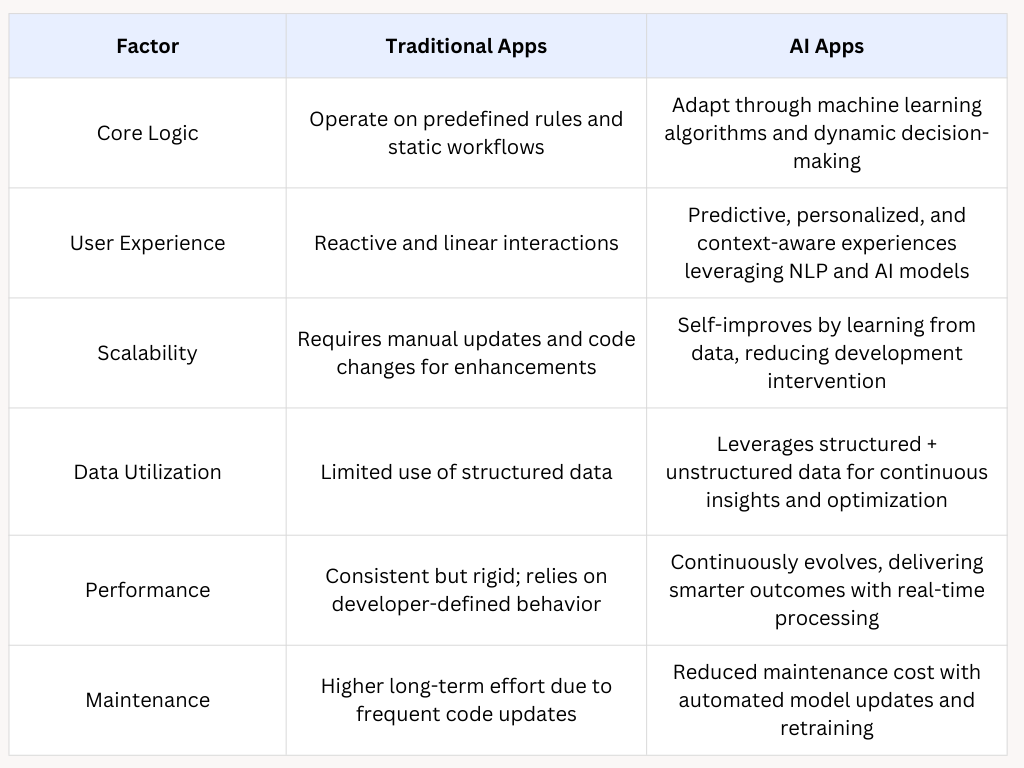
An AI app is designed to think, adapt, and act; therefore, it is not just a piece of software. An AI-based application is not static; instead, it uses machine learning, NLP, computer vision, and predictive analytics to analyze data, understand context, and evolve as the application matures (unlike traditional applications, which rely on static logic). That is the basis of building AI applications that offer intelligence, rather than functionality.
In practice, an AI application does not simply react to its input; it is foresightful and anticipatory, making decisions on its own. The ability to learn constantly and improve behavior is at the heart of AI app development in 2025. The companies that know how to develop an AI application today have a structural advantage in efficiency, cost management, and customer experience, and no legacy architecture can compare to it.
Traditional Apps vs AI-Enabled Apps: Key Differences
Why Invest in AI App Development? Key Business Benefits
Leaders should understand the business impact of creating AI-powered apps before investing in development. The benefits are objective, quantifiable, and directly related to growth, efficiency, and competitive advantage. These are what make organizations speed up their strategies to develop AI applications:
1. Revenue Growth by Personalization
The development of AI-based recommendation tools and predictive analytics opens new opportunities for personalization that conventional systems can’t achieve. Shop owners experience improved conversion rates, investment organizations achieve above-par returns, and digital platforms generate more revenue per user. This is why companies exploring AI app development tips prioritize personalization models from day one.
2. Lower Operational Costs
AI eliminates inefficiencies without affecting the quality. Healthcare teams recover hours that were spent on documentation, manufacturers save on unexpected downtime through predictive maintenance, and retailers streamline inventory through real-time demand prediction. For businesses considering the cost to build an AI app in 2025, these savings can usually pay off within months.
3. High Productivity in Workflows
AI does not simply automate repetition, but it handles judgment-driven work at scale. There are reduced delays in supply chains, balanced stock levels, and minimum human involvement in cross-functional processes. This is the operational promise of modern AI app development best practices.
4. Quickened, More Confident Decision-Making
AI systems can handle large volumes of data in a few milliseconds, enabling decisions that humans simply can’t match in speed or accuracy. Anomalies are identified by fraud detection tools, real-time rerouting by logistics platforms, and 24/7 intelligence-driven responses by customer service systems. These are the capabilities of next-generation AI development services for businesses seeking intelligent mobile apps.
5. Sustainability in Market Differentiation
Companies that develop AI applications ultimately acquire a competitive advantage. Artificial intelligence products learn and improve based on user behavior, and create competitive experiences that give them an advantage by being unique. This learning flywheel is among the strategic strengths that will shape the future of AI app development.
6. Advanced Security Assurance
AI helps security teams detect anomalies, threat modelling, and identify zero-day attacks much more quickly than conventional rule-based systems. Predictive intelligence also reduces system downtime, automates incident responses, and improves operational resilience. These are the critical deliverables for companies scaling AI-based platforms worldwide.
Maximizing the benefits of an AI app requires linking emerging AI technologies to processes. As shown, process automation with AI apps streamlines workflows, boosts efficiency, reduces costs, and ensures your technology investment drives real business impact.
How to Build an AI App: Key Steps Involved
The AI app development roadmap isn’t just about coding. It requires strategic thinking, the right team, quality data, and iterative improvement. Here’s how to approach it.
1. Specify AI Use Case and Business Value
To develop a successful AI-based app, the first step is to identify a clear and monetizable solution. Identify ways in which intelligence will decrease expenses, mechanize processes, or open up revenue. This is the groundwork for developing AI applications that meet user needs, and all technical decisions should contribute towards quantifiable business values.
2. Collect, Compile, and Manage Data
Machine learning app development relies on data as fuel. Gather both structured and unstructured data, purify it, and develop governance policies. Quality data means proper forecasts, reduced bias, and increased competitive edge- crucial in case you are adhering to AI app architecture best practices within a company setting.
3. Select the Appropriate AI models and Frameworks
Scalability and cost are determined by model selection. Compare AI frameworks using a method that covers LLMs, ML models, and vision frameworks. Assess Latency, explainability, and control first. The right foundation can fast-track innovation, minimize technical debt, and align with AI development platforms both among startups and businesses.
4. Architect the AI System
Architect a scalable system that can support model upgrades, storage of vectors, and real-time inference. Best practices in modern AI app architecture provide cost management, observability, and reliability. This architecture forms the foundation for the future of AI app development, which allows continuous learning without interrupting operations.
5. Design and Implementation of AI Basics
Build the logic that powers the app recommendation features, predictive models, NLP pipelines, or agents. Minimise the engineering time and enhance performance with the best AI development tools 2025. This phase converts business strategy into intelligence and is essential to the successful implementation of AI applications.
6. Test, Validate, and Optimize AI Behavior
AI is not deterministic; testing should involve model accuracy, hallucination control, latency, and explainability. Test on real-world scenarios and user datasets. These steps ensure readiness before release and align with AI app development best practices for enterprise-grade reliability.
7. Deploy with Monitoring and Improvement
Launch your AI app with infrastructure that monitors usage, inference costs, and model drift. Constant optimization will keep it relevant and efficient as user behavior changes. It is necessary when an individual is learning to develop an AI app step by step to enable long-term flexibility and value provision.
Key Challenges of Building an AI App
1. Quality and Availability of Data
The AI applications rely on diverse, clean, and large volumes of data. Insufficient or biased data leads to inaccurate predictions, limiting the value of AI models. It is imperative to ensure robust data pipelines, governance, and annotation frameworks to bring reliable enterprise-grade AI solutions.
2. High Development and Integration Costs
Building an AI app involves training the ML model, setting up cloud infrastructure, and integrating with the existing systems. The absence of appropriate architecture leads to a rapid cost increment. To guarantee scalable ROI and decrease TCO throughout the application lifecycle, organizations need to align AI investments with business objectives.
3. Talent and Skill Shortage
Developing an AI app will need machine learning, NLP, and MLOps specialists. The global demand for AI experts far outweighs supply, slowing innovation. Collaborating with a skilled AI development service provider helps accelerate the adoption of AI in enterprises.
4. Security and Compliance Risk
AI applications are exposed to regulatory and cybersecurity risks due to sensitive and real-time user data. Data encryption, secure APIs, role-based access, and compliance-first workflows (GDPR, HIPAA, SOC2) should be implemented to prevent breaches and support digital transformation without eroding user trust.
5. Ongoing Model Management
Unlike traditional software, AI models do not improve without retraining or fine-tuning. Data drift and real-time monitoring of model performance require robust MLOps pipelines. Through automated model governance, AI-powered applications achieve consistent accuracy and scalability in the long term.
Wrapping Up
AI-based applications have already passed the experimental phase; now they are the core of the digital business model, personalization, automation, and scale-based intelligent decision-making. There are obstacles such as data quality, security, and ongoing model management, but sustainable investment in AI by organizations will create defensible competitive advantages in the market. In a bid to speed up the innovation process, reduce risk, and ensure a smooth integration, hiring a mobile app developer with a proven background in AI becomes essential. The right talent and design will transform AI aspirations into high-performing applications that will experience scalable growth, operational excellence, and sustained competitive differentiation.
