

Transforming Patient Care: The Strategic Role of Different Data Analytics in Healthcare Infrastructure
Data is a critical entity for organizations in the digital health era, where real-time decision-making, personalized patient care, and streamlined workflow hinge on accurate, actionable insights. Healthcare data analytics plays a pivotal role in interpreting massive volumes of information. The healthcare ecosystem is generating incredible amounts of data from electronic medical records, diagnostic imaging, real-time vital signs, and administration systems – second by second.
The market size of data analytics in healthcare around the world was estimated as $29.7 billion in 2022 and is anticipated to reach $134.9 billion in 2032 with a rate of 16.7 percent between 2023 and 2032.
However, data is data; the critical steps of extracting, analyzing, and acting on the data are where the impact lies. The surge in the application of Data Analytics, especially in descriptive, diagnostic, predictive, and prescriptive data analytics, has transformed how hospitals and health tech providers provide, track, and optimize care.
CTOs and other stakeholders should learn how data analytics have been integrated into the healthcare infrastructure to come up with a scalable, intelligent, and future-proof digital health model. In this blog post, the objective is to address the importance of various data analytics in the modernization of the healthcare infrastructure, with a special emphasis on healthcare data integration as a foundation for developing connected, data-driven systems.
The Need for Data Analytics in Modern Healthcare
Healthcare is becoming complex and transforming as discoveries are made in medicine, and the wants and needs of patients evolve and are redefined. There can be no more random decision-making based on legacy records in the digital world.
Data analytics also occupies a much-needed niche by helping healthcare providers become proactive instead of dealing with reactive care. It adds discipline and intelligence to the humongous amounts of patient, clinical, and operational data generated every second. As an example, it assists in the identification of trends in patient outcomes, a stream of administrative processes, and better the performance of diagnosis and identification.
Types of Data Analytics and Their Role in Healthcare
The value of healthcare data lies in how best it can be utilized and analyzed. Primary clinical, operational, and behavioral data can be transformed into useful information through data analytics. The four types of data analytics in healthcare, descriptive, diagnostic, predictive, and prescriptive, are the building blocks of a strategic data-driven system.
The respective types determine the decisions made in the process of the healthcare lifecycle, taking organizations beyond mere collection of data to intelligent real-time decision making that can save lives, save resources, as well as ensure great patient experiences.
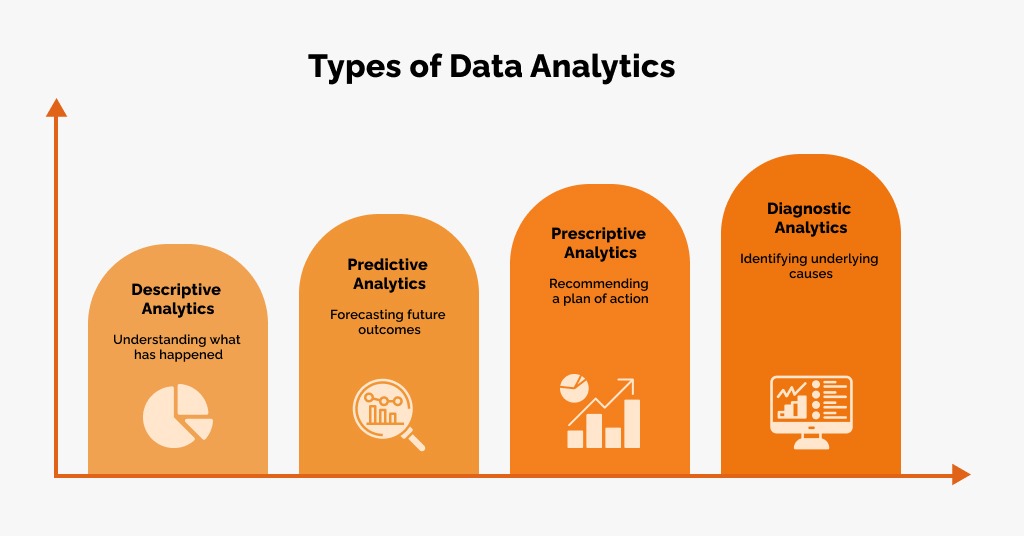
1. Descriptive Analytics
Descriptive analytics provides a retrospective view. It shows healthcare organizations what happened in the past. Descriptive analytics analyzes and aggregates past data so that organizations can recognize patterns. This may include:
- How many patients were admitted in the last year
- What departments or locations have had the most traffic
- What procedures were performed the most?
In a healthcare model, descriptive analytics drives the dashboards, reports, and summaries that allow organizations and stakeholders to:
- Understand their hospital’s performance over time
- Monitor patient traffic and outcomes of care
- Identify patterns of seasonal illness and/or treatment.
Descriptive analytics is essential to the decision-making process. It can help look at a complex system in a more simplified manner and allow for the formation of a baseline for further review and improvement. Descriptive analytics is not predictive, and it lacks deep diagnostics, but it can help identify trends at a high level and monitor improvement.
2. Diagnostic Analytics
After trends or anomalies have been detected, the next action to take is to determine the cause. This is where diagnostic analytics is applied. It investigates data relationships to answer the question of the existence of a certain outcome of why it occurred.
For instance
- Why were cardiology readmission rates up last quarter?
- Why is there a delay in scheduling surgeries for other populations?
- Why do some procedures have variation in recovery time when they are technically similar?
By going further into contributory aspects, diagnostic analytics allows clinicians and administrators to:
- Examine quality of care concerns
- Identify inefficiencies or violations in the clinical process
- Uncover gaps in clinical processes or misalignment in staffing
This type of analytics helps to implement root cause analysis, which sets the foundation to provide corrective actions and to improve clinical decision-making. It comes in handy in quality assurance, risk management, and tuning of operations.
3. Predictive Analytics
Predictive analytics is another term for an approach that combines statistical algorithms, machine learning, and historical data to predict potential future events. This method of analytics is vital for risk stratification, early response, and resource planning in healthcare.
Key applications are:
- Identifying patients at risk of developing chronic disease
- Forecasting patient volumes to the emergency room
- Predicting ICU bed demand from historical admission data
The predictive models can assist clinicians in giving them an early warning of deterioration in the health of the patient. It allows hospital administrators to make wiser staffing choices and ensure supply chain readiness.
The most valuable aspect of predictive analytics is the capacity to shift healthcare into a proactive model instead of allowing it to predominantly exist within the background of the reactive model. It enables teams to take action early to ensure less of an escalation of issues, to not only improve care quality but also operational efficiency.
4. Prescriptive Analytics
The very latest type of analytics, prescriptive analytics, not only indicates what could occur, but also prescribes actions to cause future events. It is a mixture of past information, live data, and sophisticated algorithms to give a smart recommendation.
Use cases:
- Recognizing personalized courses of treatment based on genetic information, medical history, and results trends
- Modifications to clinical processes for high-risk patients
- Informing hospital administrators of resource reallocation during a period of crisis
Prescriptive analytics finds a specific application in the clinical decision support systems (CDSS), where it dictates real-time decisions to physicians and informs them in the process of taking care of the patient. It is also used in streamlining the operations, such as:
- Staffing schedules
- Inventory management
- Emergency preparedness
Prescriptive analytics can be viewed as data science and automation merged together in front of CTOs. It is the basis for developing next-generation autonomous systems capable of learning, adapting, and making intelligent recommendations based on data, key to the future of healthcare services delivery.

Strategic Benefits of Data Analytics for Healthcare Business
Data analytics is not only technological, but it is a business enabler that will enable healthcare organizations to be smarter in their operations, provide quality care, as well as maintain pace with the increasing value-driven industry.
1. Smarter Decision-Making Across the Organization
Data analytics offers healthcare executives evidence-based information in real-time to aid in strategizing and day-to-day decision-making. Be it investing in budgets, increasing and developing services, or introducing innovations in care models, analytics makes it possible to act based on data that is convincing and tangible.
2. Improved Operational Efficiency and Cost Control
The existence of various forms of inefficiency within healthcare, like late discharges, excess supply of stock, and unnecessary readmissions, is cost-escalating and problematic to the quality of service delivery. Data analytics can be used to identify these inefficiencies so that the leadership team can streamline operations and optimize available resources.
3. Enhanced Patient Outcomes and Experience
Good quality care is no longer the clinical aim, but also a business necessity. As patient satisfaction and results of treatment gain relevance in terms of reputation, reimbursements, and loyalty, healthcare providers need to move beyond the conventional means.
4. Greater Compliance and Risk Management
Healthcare organizations are faced with major burdens to achieve regulatory compliance. The outcomes of not following the standards, such as HIPAA or GDPR, may include fines and the loss of a reputation. The way data analytics offers an intelligence layer is to be in a position to ensure compliance, track the access to the data and to be in a position to reveal risks that are about to become worse.
5. Scalability and Innovation Enablement
Healthcare providers are rapidly expanding, be it through the expansion of facilities, getting into new markets, or switching to new care models. Therefore, they need scalable systems. People are using data analytics platforms, particularly cloud-based platforms, to achieve the agility that can enable them to scale without impeding operations.
6. Competitive Advantage in a Value-Based Market
Value is king in the current healthcare scene rather than volume. The candidates are rewarded not only by the number of services provided but also according to their outcomes, efficiency, and patient satisfaction. Value-based care requires organizations to make the transition with the assistance of data analytics.
7. Reduces Medical Errors
Data analytics make healthcare more accurate and minimize medical errors as they give medical professionals on-demand insights, predictive alerts, and evidence-based suggestions. It allows recognizing the risks at the initial stages, avoiding medical mistakes with automated inspections, and facilitating research about the precise diagnosis based on the huge amount of data regarding patients. This is essential considering that the National Library of Medicine study announced a figure of around 400,000 hospitalized patients per year who suffer some form of preventable injury; furthermore, more than 200,000 deaths per year are a result of avoidable medical errors.
Concluding Thoughts
There is no competition in the healthcare sector regarding data analytics since it has become an essential feature due to the current shift to digital processes. The significance of data analytics has been concerned with the patient outcomes, streamlining of operations, and innovation of future clinical care.
Becoming data-driven has become a change of priorities among healthcare leaders who are not considering technology as something that should be adopted in isolation. It entails implementing a culture where data will serve as the key factor in every decision (clinical, operational, and financial). Whether in the form of real-time dashboards, predictive modeling, or advanced AI integrations, patient care analytics can empower organizations to become proactive in predictive analytics, personalized, and scale intelligently. In this journey, Agentic AI in healthcare data analytics is a major step to autonomously analyze patient data, coordinate multi-source inputs, and suggest real-time actions to reduce the burden on clinicians while improving outcomes.
