

Who are the Top 5 AI Public Speakers to Watch in 2026?
As artificial intelligence reshapes every industry, the world needs interpreters who can explain its opportunities, risks, and human implications. The top public speakers in AI today combine deep knowledge with storytelling and inspiration — helping audiences understand not just how AI works, but what it means.
Below are five of the most impactful AI speakers in 2026, each known for bringing clarity and vision to one of the most transformative technologies of our time.
1. Andrew Ng
Andrew Ng continues to be one of the most respected voices in artificial intelligence. As the co-founder of Google Brain and Coursera, and the founder of DeepLearning.AI, Ng bridges academia, enterprise innovation, and accessible education. His talks are clear, data-driven, and deeply practical.
Why audiences respond:
- He translates technical concepts into actionable strategies for companies adopting AI.
- His focus on “AI for Everyone” democratizes understanding of machine learning’s impact.
- He advocates for responsible, inclusive AI that benefits the global workforce.
Ng remains a cornerstone speaker for anyone who wants to grasp where AI is going — and how to harness it responsibly.

2. Cassie Kozyrkov
Formerly Google’s Chief Decision Scientist, Cassie Kozyrkov is a dynamic speaker who merges behavioral science with data strategy. In 2026, she is one of the most in-demand voices for organizations aiming to make smarter, data-informed decisions.
Why she stands out:
- She reframes AI from a technology story into a decision-making story.
- Her presentations balance humor, clarity, and deep substance.
- She empowers executives and teams to think critically about automation, human oversight, and business intelligence.
Kozyrkov’s sessions are ideal for leaders who need to operationalize AI without getting lost in technical jargon.

3. Nina Schick
Nina Schick is a leading expert on generative AI, deepfakes, and synthetic media — and one of the most compelling public speakers on the ethics and geopolitics of AI. Her insights on how generative models reshape communication, democracy, and identity make her a must-book voice for global audiences.
Key reasons she commands attention:
- She was one of the earliest analysts to forecast the cultural and political implications of deepfakes.
- Her talks combine urgency with clarity, addressing how AI alters trust and truth itself.
- She brings a global, interdisciplinary perspective — blending technology, policy, and society.
For events that explore the intersection of AI, information integrity, and public trust, Schick delivers insight with impact.
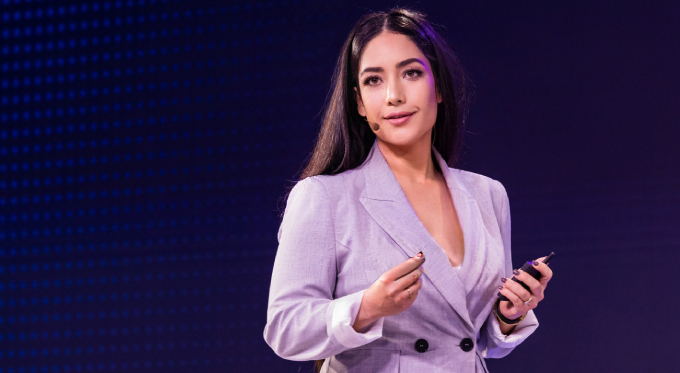
4. Erik Qualman (Equalman)
Erik Qualman — known online as Equalman — has become one of the most recognizable names in digital transformation and leadership. While he built his reputation as a bestselling author and futurist in digital media, his 2026 keynote series centers on the human side of AI: how leaders, educators, and organizations can thrive in an AI-driven world.
Why audiences love him:
- His stage energy is unmatched — he uses storytelling, data, and humor to make AI approachable.
- He explores how artificial intelligence amplifies human potential rather than replacing it.
- His bestselling books, such as Socialnomics and Digital Leader, blend seamlessly into his message about ethical and purposeful technology adoption.
Qualman’s keynotes leave audiences motivated to adapt, innovate, and lead with empathy in the digital age. He’s the go-to choice for events focused on AI, leadership, and digital transformation.

5. Kay Firth-Butterfield
Kay Firth-Butterfield brings a critical voice to the AI ethics and governance conversation. As one of the world’s first experts in AI law and former Head of AI at the World Economic Forum, she advocates for frameworks that align innovation with public good.
Why she matters:
- She translates complex ethical dilemmas into actionable guidance for companies and policymakers.
- Her experience spans technology, law, and global governance — offering a holistic understanding of AI’s societal impact.
- She emphasizes fairness, accountability, and transparency at a time when these issues dominate AI discourse.
Her speeches resonate strongly with audiences who care about how technology interacts with regulation, equity, and long-term sustainability.

Honorable Mentions and Rising Voices
Several other figures are also shaping public understanding of AI in 2026:
- Sharon Gai, recognized for explaining AI’s role in e-commerce and consumer behavior.
- Demis Hassabis, CEO of DeepMind, whose technical talks inspire innovation in research communities.
- Dr. Stephanie Hare and Rahaf Harfoush, who bring humanistic and creative lenses to the AI discussion.
- Sam Altman, OpenAI’s CEO, who continues to drive global debate on AI policy and alignment.
Each offers a distinctive approach to the same question: how can humanity and AI evolve together?
Choosing the Right AI Speaker
When selecting a speaker for your conference or corporate event, consider:
- Audience fit – technical, executive, or general.
- Perspective – innovation, ethics, or leadership.
- Tone – visionary, motivational, or cautionary.
- Industry relevance – healthcare, education, finance, or creative industries.
- Engagement style – storytelling, Q&A, or data-driven analysis.
The right speaker doesn’t just inform — they transform how audiences think about the role of intelligence, both artificial and human.
