Big Data in Construction: How Analytics Is Reducing Delays and Cost Overruns

Construction has never been a simple industry. Every project involves hundreds of moving parts, including workers, equipment, suppliers, materials, weather conditions, permits, and budgets. When even one of these factors goes off track, the entire project can suffer delays and rising costs.
For decades, construction companies relied heavily on experience, intuition, and manual reporting to make decisions. While experience remains valuable, today’s projects are becoming too large and complex to manage through guesswork alone.
This is where big data is changing the game.
The construction industry generates enormous amounts of information every day. Project schedules, equipment performance, labor productivity, weather forecasts, safety records, drone images, sensor data, procurement reports, and financial records all create valuable insights. The challenge is no longer collecting data. The challenge is turning that data into better decisions.
Companies that successfully use analytics are discovering ways to predict delays before they happen, identify cost risks early, improve productivity, and make smarter business decisions.
The result is a more efficient construction process that benefits contractors, developers, investors, and clients alike.
The Costly Reality of Construction Delays
Construction delays are not new. They have been affecting projects around the world for decades. What has changed is the scale of the problem.
According to research from McKinsey & Company, large construction projects typically take about 20% longer to finish than scheduled and can exceed budgets by as much as 80%. These figures highlight how common project overruns have become in the industry.
A delayed project affects more than timelines. It can increase labor costs, delay revenue generation, create supply chain disruptions, and damage relationships with clients.
For commercial projects, every month of delay can translate into significant financial losses.
Infrastructure projects face similar challenges. Cost overruns can place pressure on public budgets, reduce investor confidence, and create political concerns.
Many of these problems stem from a lack of visibility. Project leaders often discover issues only after they have already become expensive. Big data helps solve this problem by providing real-time information and predictive insights.
Why Construction Is Becoming a Data-Driven Industry
The modern construction site looks very different from the one that existed ten years ago.
Today, projects use:
- Drones for site inspections
- GPS-enabled equipment
- Building Information Modeling (BIM)
- IoT sensors
- Mobile applications
- Cloud-based project management platforms
- Artificial intelligence tools
Each of these technologies produces data.
According to industry research from Autodesk, the construction sector is experiencing rapid digital transformation as companies increasingly adopt connected technologies and cloud-based platforms to improve project performance.
Instead of storing information in separate spreadsheets, organizations can now combine data from multiple sources and analyze it in one place. This creates a much clearer picture of project performance. Project managers can identify problems earlier, monitor progress more accurately, and respond faster when risks emerge.
What Exactly Is Big Data in Construction?
Big data refers to extremely large and complex datasets that traditional systems struggle to process efficiently.
In construction, big data may include:
- Project schedules
- Budget reports
- Procurement records
- Equipment performance data
- Worker productivity metrics
- Weather information
- Drone imagery
- Safety reports
- Sensor readings
- Site photographs
- Material tracking data
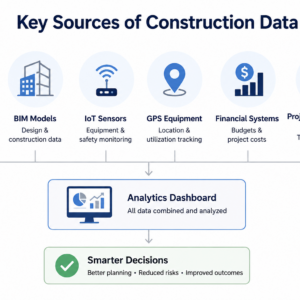
When analyzed together, these datasets reveal patterns that would otherwise remain hidden.
For example, analytics may show that a particular supplier consistently causes delivery delays during specific months. It may reveal that certain equipment requires maintenance before breakdowns occur. It may identify productivity trends across multiple projects.
These insights allow companies to move from reactive management to proactive decision-making.
The Growing Market for Construction Analytics
Investment in construction technology continues to increase as organizations recognize the value of data-driven decision-making. According to Statista, global spending on construction technology has increased significantly over the past several years, driven by demand for automation, digital workflows, and predictive analytics.
Technology providers such as Autodesk, Procore, Trimble, Oracle, and Bentley Systems are expanding their analytics capabilities to help construction firms improve performance.
This growth reflects a broader shift within the industry. Construction companies are no longer viewing technology as a support function. They are increasingly treating data as a strategic business asset.
Common Sources of Construction Data:
| Data Source | Information Collected | Business Value |
| Project Management Software | Schedules, tasks, milestones | Improved project tracking |
| IoT Sensors | Equipment performance, site conditions | Predictive maintenance |
| Drones | Site imagery and progress updates | Better monitoring |
| BIM Systems | Design and building information | Improved coordination |
| Financial Systems | Budgets, expenses, invoices | Cost control |
| GPS Equipment | Location and movement tracking | Resource optimization |
| Safety Platforms | Incident reports and compliance data | Risk reduction |
| Weather Data | Forecasts and environmental conditions | Better planning |
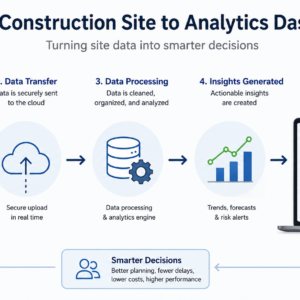
How Analytics Helps Reduce Project Delays
Project delays rarely happen because of a single issue. Most delays result from a combination of factors that build up over time.
These may include:
- Material shortages
- Labor shortages
- Equipment failures
- Poor communication
- Design changes
- Scheduling conflicts
- Unexpected weather events
Analytics helps organizations identify these risks much earlier.
Predictive Scheduling
Traditional schedules often rely on assumptions. Predictive analytics uses historical project data to identify patterns and estimate future outcomes more accurately.
For example, if previous projects show that foundation work often takes longer during rainy seasons, analytics software can automatically adjust scheduling recommendations.
Project managers can then allocate additional resources or modify timelines before delays occur.
This proactive approach reduces surprises and improves planning accuracy.
Real-Time Project Monitoring
One of the biggest advantages of analytics is real-time visibility. Instead of waiting for weekly reports, project teams can track performance continuously.
Dashboards can display:
- Progress against schedule
- Budget performance
- Workforce productivity
- Equipment utilization
- Safety metrics
When problems emerge, managers can respond immediately. This reduces the risk of small issues becoming major delays.
Better Resource Allocation
Construction projects often struggle with resource management. A shortage of skilled workers can delay progress. Too many workers assigned to the wrong task can create inefficiencies.
Analytics helps companies understand how resources are being used.
Managers can identify:
- Underutilized equipment
- Labor shortages
- Scheduling conflicts
- Productivity bottlenecks
By optimizing resource allocation, companies can maintain project momentum and avoid costly disruptions.
The Role of Artificial Intelligence in Construction Analytics
Artificial intelligence is making construction analytics even more powerful. AI systems can analyze vast amounts of data much faster than human teams. Instead of reviewing thousands of project records manually, AI can identify trends and risks within minutes.
For example, AI tools may detect that a project is showing early signs of delay based on workforce productivity, procurement data, and weather forecasts. This allows managers to take corrective action before the schedule is affected.
According to Deloitte, AI and advanced analytics are becoming increasingly important across engineering and construction organizations as firms seek greater efficiency, productivity, and risk management. The combination of AI and big data is creating new opportunities for smarter project delivery.
How Drones Are Improving Project Visibility
Drones have become one of the most valuable data collection tools in construction. Regular drone flights provide accurate visual records of project progress. These images can be compared with project schedules and BIM models to identify discrepancies.
Benefits include:
- Faster site inspections
- Improved progress tracking
- Better stakeholder communication
- Reduced manual surveying costs
- Earlier identification of potential delays
When combined with analytics platforms, drone data provides a near real-time view of project status. This level of visibility was difficult to achieve just a few years ago.
Equipment Analytics and Predictive Maintenance
Equipment breakdowns are among the most common causes of project disruptions. Heavy machinery plays a critical role in construction operations. When equipment fails unexpectedly, work often stops.
Modern equipment now includes sensors that collect data on:
- Engine performance
- Fuel consumption
- Operating hours
- Temperature levels
- Mechanical health
Analytics systems use this information to predict maintenance needs before failures occur. Instead of repairing equipment after it breaks down, companies can perform maintenance proactively.
This reduces downtime and helps keep projects on schedule.
Organizations using predictive maintenance strategies often experience lower maintenance costs and improved equipment availability compared with reactive maintenance approaches.
Data Analytics in Specialized Construction Projects
The value of analytics extends across nearly every construction segment. Commercial developers use data to improve scheduling and cost forecasting. Infrastructure organizations use analytics to manage large and complex public projects.
Industrial facilities use predictive maintenance to improve operational reliability. Even projects involving metal buildings increasingly rely on data-driven planning tools to optimize material delivery schedules and workforce coordination.
As projects become more complex, the ability to make informed decisions quickly becomes a competitive advantage.
From Gut Feeling to Data-Driven Decision Making
Construction has traditionally been an experience-driven industry. Experienced project leaders remain essential, but data is adding a new layer of intelligence. The most successful companies are combining industry expertise with analytics.
Instead of asking, “What do we think will happen?”
They are asking, “What does the data suggest is likely to happen?”
That shift may seem small, but it represents one of the biggest transformations the industry has seen in decades.
How Analytics Is Reducing Cost Overruns
While delays often receive the most attention, cost overruns can have an even greater impact on construction projects. A project that finishes late can still succeed if it remains profitable. A project that significantly exceeds its budget creates problems for everyone involved.
Unfortunately, cost overruns remain common across the industry.
Construction budgets are affected by numerous variables, including labor costs, material prices, equipment expenses, design changes, and supply chain disruptions. Tracking all these factors manually is difficult, especially on large projects.
Big data allows companies to monitor financial performance continuously rather than reviewing costs only at major milestones.
Early Detection of Budget Risks
One of the biggest advantages of analytics is the ability to identify budget risks before they become major financial problems. Traditional project management often relies on periodic reviews. By the time managers discover a cost issue, the damage may already be done.
Analytics platforms continuously compare actual spending against planned budgets. When spending begins to exceed expectations, alerts can notify project teams immediately.
For example, if labor costs on a project start rising faster than forecasted, managers can investigate the cause and make adjustments before the issue spreads across the project.
This proactive approach helps reduce financial surprises.
Improving Material Cost Management
Material costs represent a significant portion of construction budgets. Price volatility has become a major concern in recent years due to global supply chain disruptions, inflation, and changing market conditions.
Analytics tools help companies track:
- Material consumption
- Supplier performance
- Delivery schedules
- Inventory levels
- Procurement costs
This information improves purchasing decisions and reduces waste. Project teams can forecast material needs more accurately and avoid expensive last-minute purchases.
According to the Associated General Contractors of America, construction input prices continue to experience fluctuations that directly impact project costs. Better forecasting and procurement planning can help companies manage these risks more effectively.
Reducing Rework Through Better Data
Rework is one of the most expensive problems in construction. Errors in design, communication, or execution often require work to be repeated. This increases labor costs, delays schedules, and wastes materials. Analytics helps reduce rework by improving visibility across the project.
When project information is centralized and updated in real time, teams can identify issues earlier. Data collected from BIM systems, inspections, drones, and field reports helps ensure everyone is working from the latest information. The result is fewer mistakes and lower costs.
Real-World Examples of Data-Driven Construction
Many leading construction technology companies are helping the industry embrace analytics.
Autodesk:
Autodesk has played a major role in digital construction through BIM, cloud collaboration, and analytics solutions. Its platforms help project teams analyze project data, improve coordination, and identify risks earlier.
Many organizations use Autodesk tools to connect design data with construction performance metrics, creating better visibility throughout the project lifecycle.
Procore:
Procore provides cloud-based construction management software used on projects around the world. Its platform helps teams track budgets, schedules, productivity, and field operations in real time.
By bringing project data into a single environment, companies can make faster and more informed decisions.
Trimble:
Trimble combines hardware, software, and analytics solutions to improve construction efficiency. Its technologies support equipment tracking, site positioning, project monitoring, and data analysis.
Construction companies use these insights to improve productivity and reduce operational waste.
Oracle:
Oracle offers project management and analytics solutions that help organizations manage complex construction programs.
Large infrastructure and commercial projects often use Oracle platforms to monitor budgets, schedules, and project risks.
Bentley Systems:
Bentley Systems focuses on digital engineering and infrastructure intelligence.
Its solutions help organizations analyze data across transportation, utilities, industrial facilities, and large infrastructure projects.
These examples show that analytics is no longer an experimental technology. It has become a practical business tool used by organizations of all sizes.
The Rise of Predictive Analytics
Many companies already use analytics to understand what happened in the past. The next stage is predicting what will happen in the future. Predictive analytics uses historical and real-time data to forecast outcomes.
Instead of simply reporting project status, predictive systems can estimate:
- Potential schedule delays
- Future budget overruns
- Equipment failures
- Safety risks
- Resource shortages
This capability allows organizations to act before problems occur. For example, if analytics suggests that a project has a high probability of missing a milestone, managers can increase staffing, adjust schedules, or resolve bottlenecks before delays happen.
This shift from reactive management to predictive management represents one of the most important changes in modern construction.
Safety Analytics Is Delivering Additional Value
Construction remains one of the world’s most challenging industries from a safety perspective. Safety incidents can cause injuries, delays, legal issues, and financial losses. Big data is helping companies improve safety performance through better monitoring and risk analysis.
Analytics platforms can evaluate:
- Near-miss reports
- Incident records
- Equipment usage
- Worker movement patterns
- Environmental conditions
These insights help organizations identify high-risk situations before accidents occur.
Wearable devices and connected sensors are also becoming more common on construction sites. These technologies generate valuable safety data that can be analyzed to improve site conditions and worker protection.
According to the Occupational Safety and Health Administration (OSHA), proactive safety management remains one of the most effective ways to reduce workplace incidents. Analytics provides construction companies with additional tools to support these efforts.
How Analytics Creates Business Value in Construction:
| Challenge | Traditional Approach | Analytics-Driven Approach |
| Schedule Delays | React after delays occur | Predict delays before they happen |
| Cost Overruns | Review budgets periodically | Monitor spending continuously |
| Equipment Failures | Repair after breakdown | Predict maintenance needs |
| Safety Risks | Investigate incidents afterward | Identify risks proactively |
| Resource Allocation | Manual planning | Data-driven optimization |
| Material Management | Historical estimates | Real-time forecasting |
| Project Reporting | Static reports | Live dashboards and alerts |

Why Data Quality Matters
Big data is only valuable when the information is accurate. Poor-quality data can lead to poor decisions. Many construction companies still struggle with:
- Incomplete records
- Inconsistent reporting
- Data silos
- Manual data entry errors
Successful analytics programs require strong data governance. Organizations must establish clear processes for collecting, storing, and managing information. They also need to ensure that project teams understand how data is being used.
Technology alone cannot solve problems. Reliable data and strong leadership are equally important.
Challenges Slowing Analytics Adoption
Despite its benefits, analytics adoption still faces obstacles. Here are some reasons that slow analytics adoption.
Resistance to Change
Construction has a long history of traditional working methods. Some organizations remain hesitant to adopt new technologies. Leaders may worry about costs, complexity, or workforce adoption. However, companies that delay digital transformation risk falling behind competitors.
Skills Gaps
The industry needs professionals who understand both construction and data analysis. Finding talent with expertise in both areas can be difficult. Many organizations are investing in training programs to help employees develop digital skills.
Integration Challenges
Construction firms often use multiple software systems. Connecting data across these platforms can be complicated. Fortunately, technology providers are increasingly focusing on integration and interoperability. As these capabilities improve, data sharing becomes easier.
The Future of Big Data in Construction
The construction industry is only beginning to unlock the full value of analytics. Several trends are expected to shape the future.
Artificial Intelligence Will Become More Advanced
AI systems will continue improving their ability to analyze complex project data. Future platforms may automatically recommend actions, optimize schedules, and identify risks with greater accuracy.
Digital Twins Will Gain Momentum
Digital twins create virtual representations of physical assets. These models continuously receive real-world data from sensors and connected systems. Project teams can use digital twins to monitor performance, predict maintenance needs, and improve decision-making.
More Connected Job Sites
Construction sites are becoming increasingly connected through IoT devices, sensors, drones, and mobile applications. This connectivity will generate even more data and create new opportunities for analytics.
Sustainability Analytics
Environmental performance is becoming a priority for developers, investors, and regulators. Analytics can help organizations monitor energy consumption, carbon emissions, material efficiency, and sustainability goals. This capability will become increasingly important as environmental regulations evolve.
Final Thoughts
The construction industry has always depended on experience, craftsmanship, and strong project management. Those strengths will remain important for years to come. What is changing is the amount of information available to support decision-making.
Companies no longer need to rely solely on intuition when evaluating project risks. They can use analytics to identify patterns, predict outcomes, and respond faster to emerging challenges. The organizations that embrace big data are discovering new ways to reduce delays, control costs, improve safety, and increase productivity.
This is not simply a technology trend. It represents a fundamental shift in how construction projects are planned, managed, and delivered. The future of construction will not be built on data alone. It will be built by combining human expertise with data-driven intelligence.
Companies that successfully balance both will be in the strongest position to compete in an increasingly complex and demanding industry.